
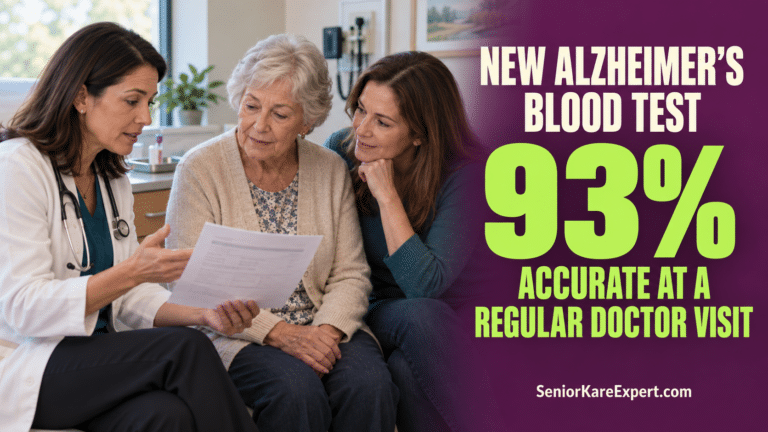
I hear a version of the same story from a lot of daughters. She’s noticed her mom is repeating the same question five or six times in an hour. Forgetting appointments. Forgetting names that used to come to her instantly. And she hasn’t said anything, because she’s afraid of frightening her mother, and honestly, a little afraid of finding out she’s right.
So she waits. Maybe she mentions it at the next checkup, carefully, the way you’d bring up something you’re not sure you’re allowed to say out loud. And her mom, sitting in the exam room, pulls it together for fifteen minutes and answers the doctor’s questions just fine. The doctor isn’t concerned. Everybody exhales. Nothing changes, except the thing you noticed is still there when you get home.
If that sounds familiar, I want to tell you about something that happened this summer, because it might change how that visit goes.
The Three-and-a-Half-Year Wait For A Dementia Diagnosis
Researchers who pooled data from thirteen studies covering more than 30,000 people found that the average gap between the first noticeable symptom of dementia and an actual diagnosis is 3.5 years. For families dealing with early-onset dementia, it stretches to 4.1 years. The researchers pointed to a familiar chain of reasons: symptoms get written off as normal aging, families hesitate to push the issue, primary care doctors are slow to refer out, and the specialists families do get referred to have long waitlists.
None of that will surprise you if you’ve lived it. What’s new is that one part of the process just got a lot shorter.
What a Study Out of Sweden Actually Found
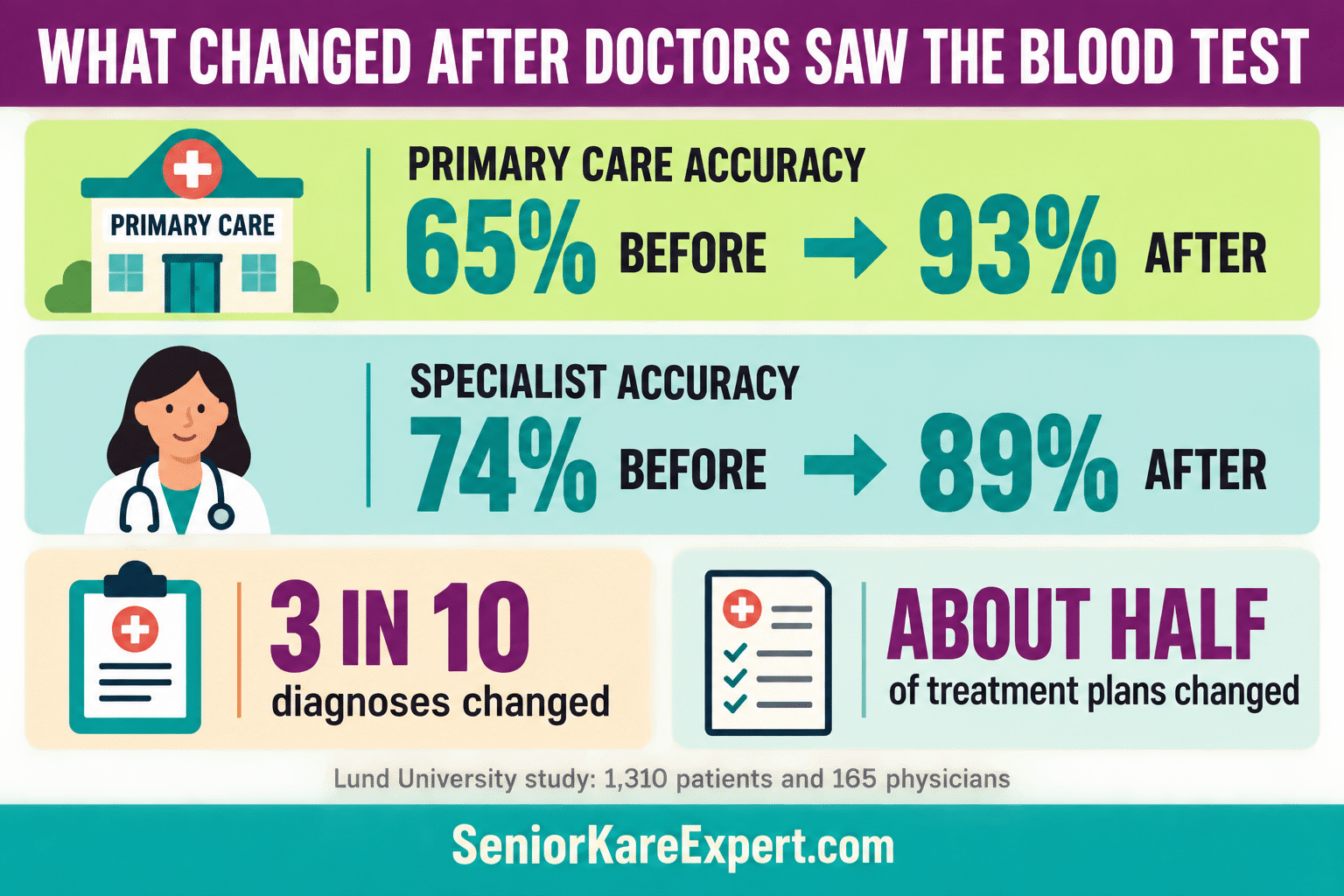
In July, researchers at Lund University published the results of a real-world study involving 1,310 patients and 165 physicians. The study looked at what happened when primary care doctors used a blood test (measuring amyloid and phosphorylated tau, the same proteins specialists look for) as part of a regular office visit, rather than sending the patient down the road to a memory clinic.
Before the blood test, primary care doctors diagnosed correctly about 65% of the time. Specialists, using their usual tools, were right about 74% of the time. After reviewing the blood test results, primary care accuracy jumped to 93%, essentially closing the gap with specialist-level accuracy (89% after the same test). The doctors changed their diagnosis for three out of ten patients after seeing the results, and changed the treatment plan in about half of all cases. For patients who tested negative, doctors felt confident ruling out Alzheimer’s twice as often as they had before.
Dr. Sebastian Palmqvist, who led the study, put it plainly: accurate diagnosis has mostly been something you could only get at a specialist’s office. This is the first strong evidence that a regular primary care visit can get you there too.
What This Doesn’t Mean
I want to be careful here, because there’s a difference between what this study showed and what you might see advertised at the pharmacy. This was a blood test ordered by a doctor, interpreted by a doctor, and combined with a full clinical picture. It is not the same thing as a direct-to-consumer test you order online and read yourself. Researchers at Stanford and the Alzheimer’s Association have both raised real concerns about those at-home versions, warning that an unsupervised result can be a “fuzzy answer” that tells you something is elevated without telling you what to do next, or worse, causes needless panic over a result nobody helped you interpret.
The version that matters for your family is the one you ask your parent’s own doctor about, at a visit, where someone qualified can walk you through what it means.
What To Do If You Suspect A Dementia Issue
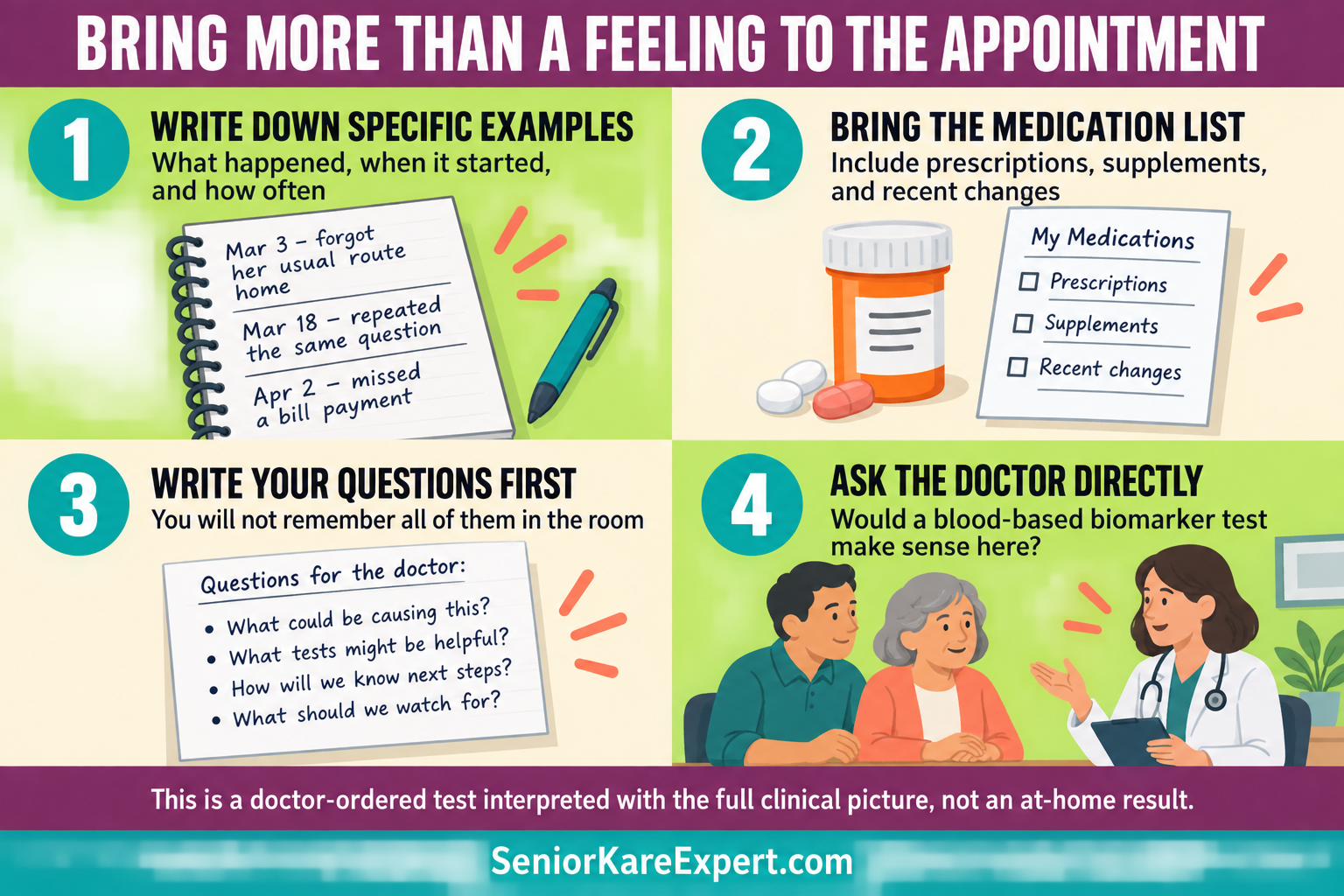
If you’ve been sitting on a growing list of things you’ve noticed, here’s the shift: you no longer have to convince a skeptical doctor to send your parent to a specialist and then wait months for that appointment to open up. You can ask your parent’s primary care doctor directly whether a blood-based biomarker test makes sense as part of the visit.
The Alzheimer’s Association recommends coming prepared, the same way you’d prep for any appointment where you’re worried you won’t get through everything. Before you go, write down specific examples of what you’ve noticed and when it started, not just “her memory is bad,” but the actual moments: she asked about the same appointment three times in one phone call, she left the stove on, she got lost driving somewhere she’s driven for twenty years. Bring a list of her current medications. Bring your questions in writing, because you will forget half of them once you’re in the room, everybody does.
I’ve written before about how families can evaluate what they’re actually seeing before that appointment, so you’re not walking in with just a feeling. It’s not a diagnosis, but it turns “something feels off” into a specific, dated list a doctor can act on.
The Part Nobody Tells You
Here’s what I’ve watched happen to the daughters in this situation, separate from whatever the diagnosis turns out to be. Their own lives get smaller while they wait. They sleep worse, half-listening for a sound down the hall. They stop mentioning to anyone else how tired they are, because it still feels like their job to carry it quietly. That toll is real whether or not there’s a name for what’s happening to their parent yet, and it’s worth naming on its own. I wrote more about that emotional weight caregivers carry if you want to know you’re not imagining that part either.
And if some part of you has been holding off because asking for help, or asking for a real diagnosis, feels like giving up on handling this yourself: it isn’t. I’ve said this before and I’ll keep saying it, getting help doesn’t mean you’re failing her. It means you noticed something worth taking seriously, and now there’s finally a faster way to find out if you’re right.
You’re not overreacting. Follow what you’ve noticed. Write it down. Make the appointment, and ask specifically about the blood test. A year from now, “where do I even start” doesn’t have to still be the question you’re stuck on.
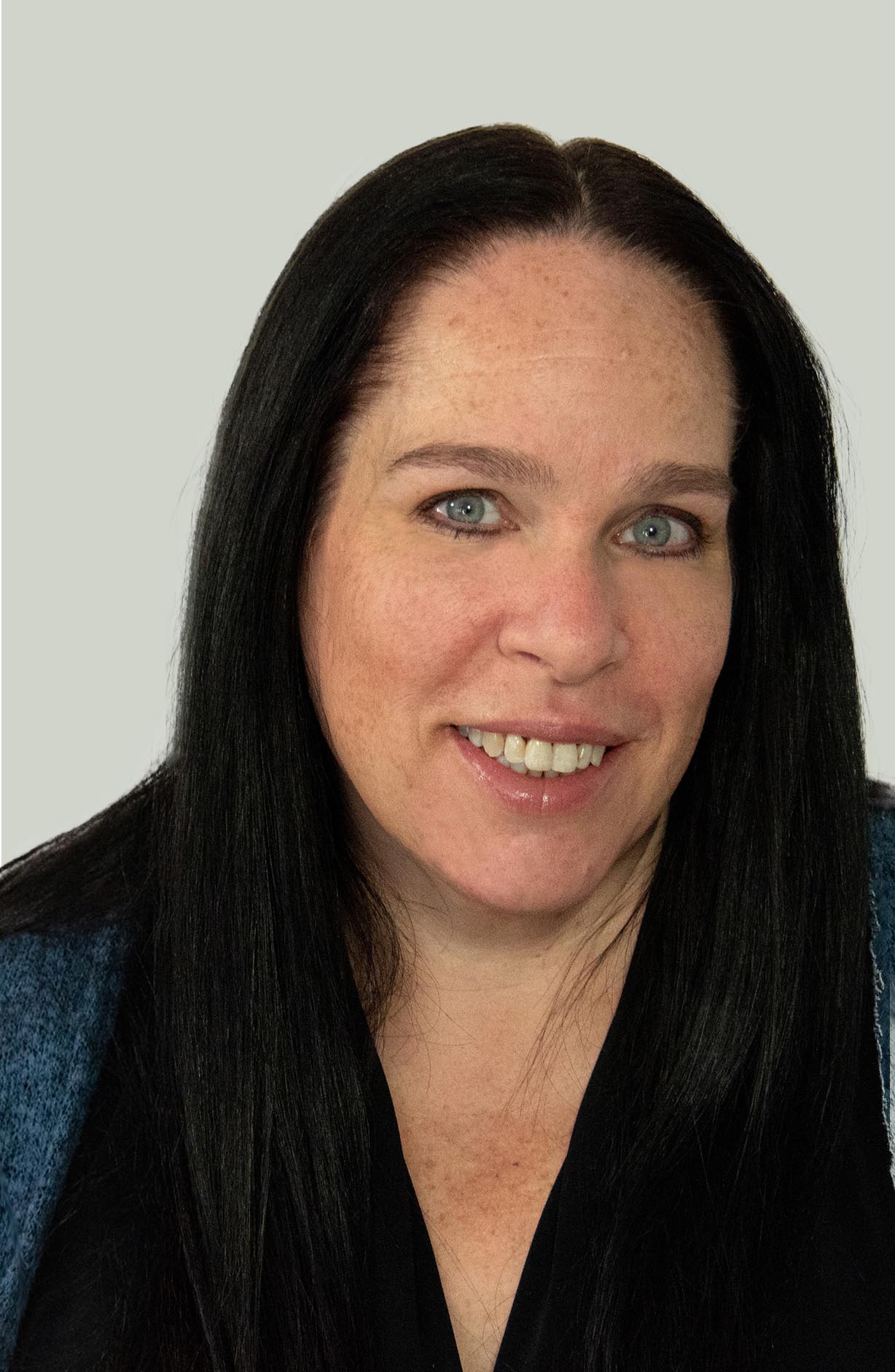
Stacey Eisenberg’s connection to senior care didn’t start with a job posting. It started at age three, in the activity room of a Coney Island nursing home where her mother worked. Growing up inside nursing homes in the 1970s and ’80s, she witnessed what genuine caregiving looked like before the industry got complicated by paperwork, liability, and the relentless pressure to do more with less. That became the standard she has spent her career trying to restore — bringing the Care back to caregiving.
By 13, Stacey had her first official job in senior care. Over the past four decades, she has worked across virtually every setting: nursing homes, assisted living communities, memory care residences, rehab centers, hospitals, and independent living. She served as Director of Fun for nearly 300 independently living seniors, coordinating daily events, activities, and outings.
Today, Stacey and her husband Bryan own A Place At Home – North Austin, an award-winning home care agency serving families across Round Rock, Georgetown, Cedar Park, Leander, Hutto, and surrounding Central Texas communities. Their agency has been voted Best Home Care Agency in Round Rock two years running (2024 and 2025) and received national recognition from Activated Insights as both a Best of Home Care Provider of Choice and Employer of Choice in 2025.
Stacey is a trained recreation therapist and serves as a Community Educator for the Alzheimer’s Association: Capital of Texas chapter. She serves as Treasurer on the Adult Protective Services Advisory Board and as Community Awareness Chair for the Aging Services Council. She co-facilitates the Williamson County Health Resource networking group and is a member of the National Aging in Place Coalition. In 2025, she was recognized as a finalist in the Woman of Wilco awards and is the creator of Peter’s Memory Beads, a passion project to raise funds for the Alzheimer’s Association.
Her expertise has been featured in U.S. News and World Report, AARP, and Care.com.