
A simple way to keep hands busy, minds engaged, and moments meaningful.
Created for seniors and the caregivers who support them, Peter’s Memory Beads offer a gentle, hands-on brain health activity that encourages focus, touch, counting, conversation, and connection. All proceeds from sales of Peter’s Memory Beads go towards the Alzheimer’s Association.
THE STORY
Where They Come From
Peter’s Memory Beads were inspired by a remarkable man named Peter, who lived to 116 in the first nursing home Stacey Eisenberg worked in. Though he was blind and spent much of his time seated, he kept his mind active by counting beads.
That simple act, repeated with attention and purpose, became more than a pastime. It became a way to stay engaged.
Peter’s Memory Beads were created to honor that idea: that something small, simple, and tactile can help keep the mind working while also bringing calm, comfort, and connection. This is supported by recent brain health science.
THE PRODUCT
What Are Peter’s Memory Beads?
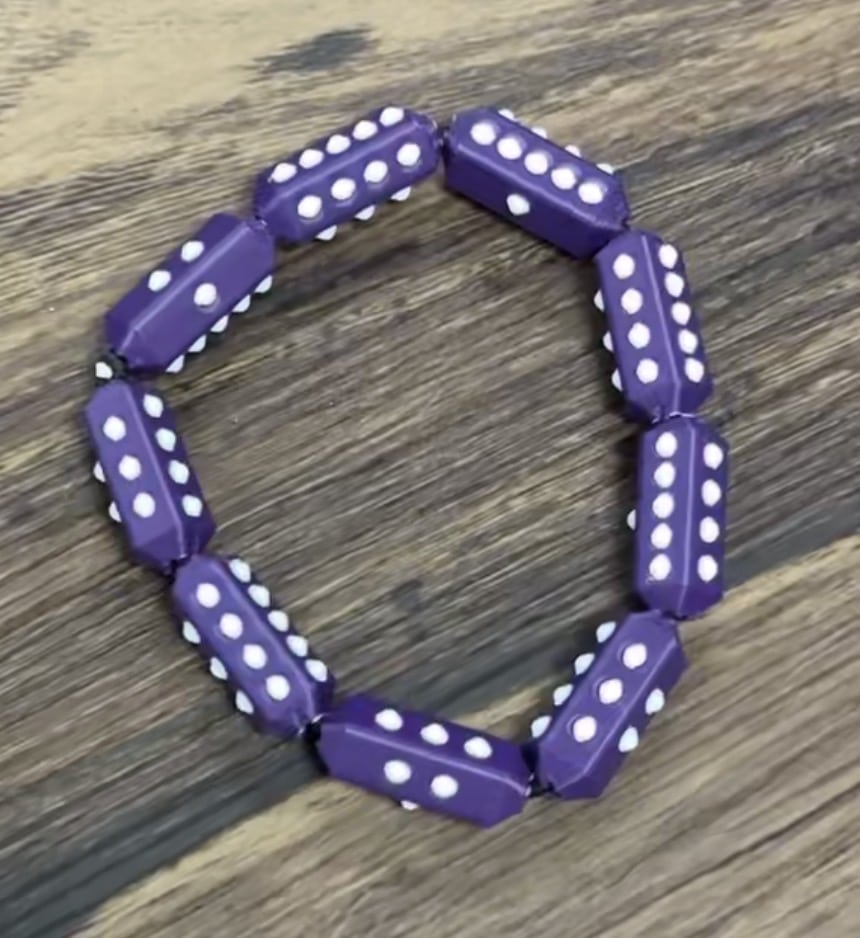
Peter’s Memory Beads are a bracelet-style set of tactile dice beads, designed for simple brain engagement activities. Easy to use alone or with the help of a caregiver.
Each bead can be used for:
| Counting – up and down | Addition and subtraction | Multiplication and division | Pattern recognition | Sensory matching by touch | Memory exercises | Quiet focus and calming repetition |
WHY IT MATTERS
The Best Tools Are Often the Simplest
For many seniors, especially those who benefit from gentle cognitive engagement, complex doesn’t mean better. Peter’s Memory Beads encourage:
| Mental activity | Hand-eye coordination |
| Tactile awareness | Focus and concentration |
| Calm repetitive motion | Caregiver connection |
This is not about pressure or performance. It is about staying engaged in a way that feels safe, familiar, and approachable.
ACTIVITIES
Simple Games to Play
| Count Down Start at 20, 50, or 100. Move bead by bead and subtract until you reach zero. |
Count Up Choose a target number and add each bead until you reach it. |
Match the Bead Close your eyes, feel a bead, and guess the number before looking. |
| Multiply Around Pick a number like 2, 3, or 5 and multiply each bead as you move around the bracelet. |
Divide and Solve Use each bead for simple division practice, adjusted to the user’s comfort level. |
Odd or Even Identify whether each bead number is odd or even as you move along. |
| Memory Loop Look at 3 or 4 beads, then look away and try to recall them in order. |
Pattern Finder Look for repeated numbers, pairs, or sequences in the bracelet. |
Calm Counting Move slowly through the beads while breathing deeply. Count with each touch. |
FOR CAREGIVERS
More Than an Activity
Caregivers can use Peter’s Memory Beads as a point of connection, not just a task to fill time. A few simple things to keep in mind:
- Keep the pace relaxed
- Offer encouragement, not correction
- Adjust the game to the person’s ability
- Use the beads as a conversation starter
- Focus on participation, not perfection
Sometimes the value is not in getting the right answer. Sometimes the value is in the smile, the focus, the calm, or the shared moment.
WHO THEY’RE FOR
A Good Fit For
| Seniors who enjoy tactile activities | Caregivers looking for simple engagement tools |
| Families wanting meaningful activities to share | Adults recovering from stress or cognitive overload |
| Anyone who benefits from calming, hands-on focus | |
Stacey and her husband Bryan Eisenberg designed and produce these beads locally in Round Rock, TX with the support of RR3D.
THE RESEARCH
What the Science Says About Sensory Engagement
| 36% Reduction in agitation through tactile stimulation in dementia patients Journal of Clinical Nursing, 2009 |
88.7% Of caregivers reported improved engagement using sensory-based activities American Journal of Alzheimer’s Disease, 2016 |
42% Decrease in anxiety-related behaviors with repetitive hand-based activities Dementia and Geriatric Cognitive Disorders, 2017 |
3x Longer sustained attention during tactile tasks compared to screen-based activities Geriatric Nursing, 2018 |
Research consistently shows that simple, hands-on sensory activities can make a real difference for people living with cognitive decline. Here’s what we know:
Tactile stimulation reduces agitation. A 2009 study in the Journal of Clinical Nursing found that structured touch-based activities significantly reduced agitation among residents with moderate to severe dementia — by as much as 36%. Activities involving beads, textured objects, and repetitive hand movements were among the most effective.
Repetitive motion supports emotional regulation. Counting, sorting, and sliding beads along a string engages what researchers call “procedural memory” — the kind of memory that often remains intact even in later stages of Alzheimer’s. A 2017 study in Dementia and Geriatric Cognitive Disorders documented a 42% decrease in anxiety-related behaviors when patients engaged in repetitive hand-based activities.
Sensory activities improve caregiver-reported engagement. In a 2016 study published in the American Journal of Alzheimer’s Disease, 88.7% of caregivers observed meaningful improvement in patient engagement when sensory-based activities were introduced into daily routines. The effect was strongest with activities that were easy to start, required no instruction, and could be done together.
Hands-on tasks hold attention longer than screens. A 2018 study in Geriatric Nursing found that older adults with cognitive impairment sustained attention up to three times longer during tactile tasks compared to screen-based activities. The physical act of touching and manipulating objects created a stronger sensory anchor.
All proceeds from sales of Peter’s Memory Beads go to the Alzheimer’s Association. Currently we can only receive payment by check or cash (in person). If you are interested in ordering, please contact Stacey for details. We believe in supporting both the people living with this disease and the research working to end it.
A simple tool. A meaningful moment.
Not every helpful thing needs a screen, a subscription, or a manual thick enough to stop a door. Sometimes all it takes is something to hold, something to count, and someone to share the moment with.
That is the heart behind Peter’s Memory Beads.