

You did the responsible thing. You researched agencies with good reviews, spoke to a few, picked one that you heard of before, and hired help for your parent. In your head, that was the moment your job as daily caregiver got handed off.
Then the aide called out sick, and nobody from the agency called you until you called them. You spent twenty minutes on hold explaining, again, what your mom needs and doesn’t need, to someone who’d never met her. You found yourself sweeping the kitchen floor yourself because it was faster than waiting for it to come up in someone else’s rotation. And somewhere in there you thought: what was the point of hiring a caregiver if I still have to be on call when they don’t show up? Or your mom gets frustrated by the steady stream of strangers who know virtually nothing about her the agency decided to send next to fill the empty shift.
If that sounds familiar, you’re not imagining it, and you’re not doing it wrong.
The Data Says You’re Not Imagining It
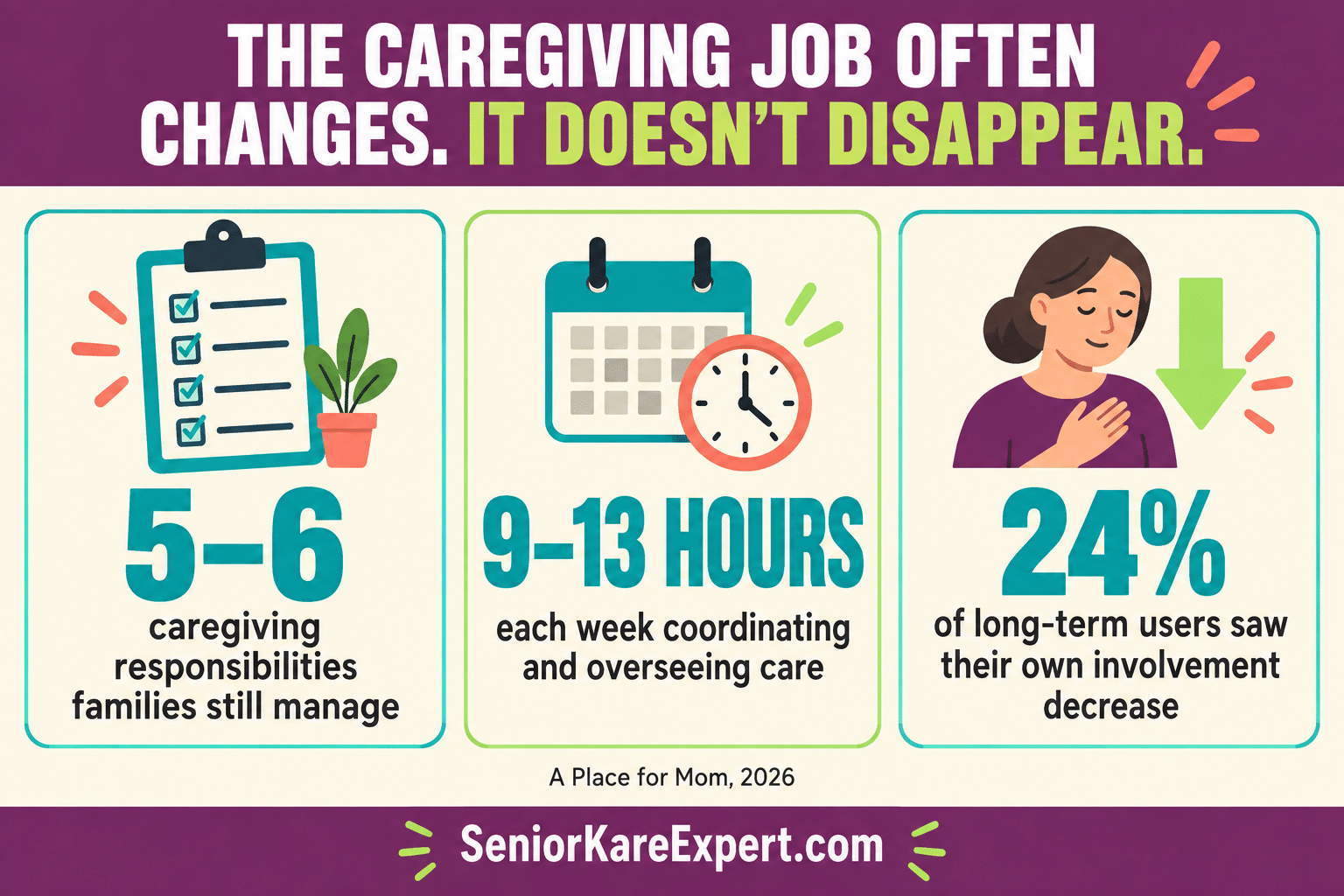
A Place for Mom’s 2026 report on home care, “What Makes Home Care Work,” surveyed 708 family caregivers across the full journey, from people just starting to search to people who’d used a home care agency for a year or more. The data point that should get your attention before making a choice: even after hiring professional caregivers, families keep managing an average of five to six caregiving responsibilities themselves, and spend roughly nine to thirteen hours a week coordinating and overseeing that care. Fifty-four percent of long-term users said their own involvement “stayed about the same” after care began. Only about a quarter saw it actually go down.
Nine to thirteen hours is a second part-time job. It’s not the job of bathing and feeding and lifting, but it’s the job of coordination, remembering, tracking, translating, and following up, and it’s the job nobody warned you about when you signed the contract.
A Care.com report released this summer found that sandwich generation caregivers took on dual responsibilities at an average age of 34, and 86% felt completely unprepared when it happened. Nobody hands you a job description. You learn the job by doing it, struggling at first, and then you hire professional help expecting to ease the load. Instead it just moves to a different subject: managing the people you hired.
Why “We Sent Someone” Isn’t the Same As “It’s Handled”
Here’s the part agencies don’t put in the brochure. Turnover in this industry is brutal (nearly 80%) almost everywhere. Families who’ve been through it describe getting “warm bodies” instead of a matched, trained caregiver. They describe not knowing who to call, getting transferred, leaving messages that don’t get returned. One family put it plainly in a review I read recently: terrible communication and follow-up, and it added more stress than they could say.
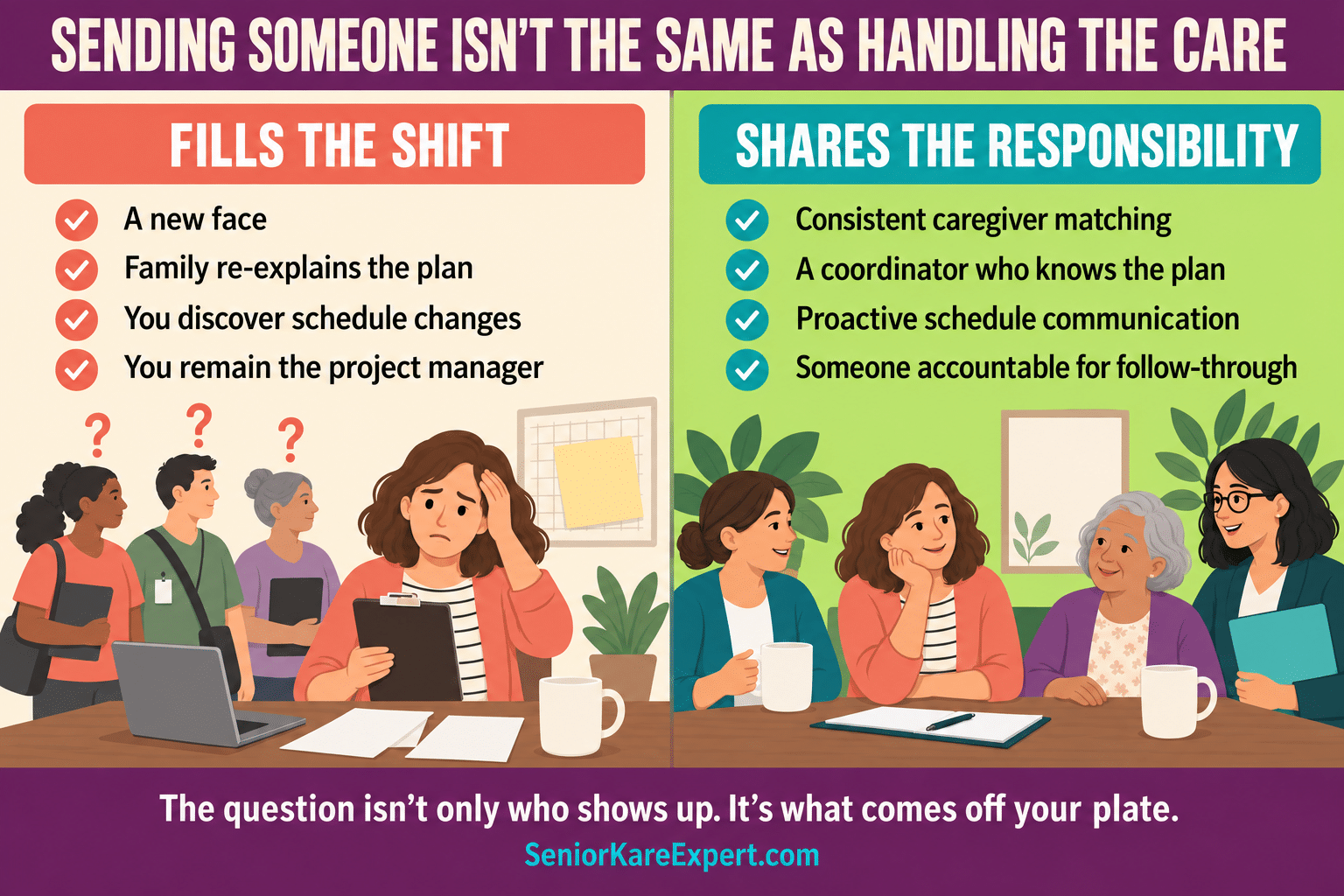
None of that is a reflection on you or on whether you picked wisely. It’s a reflection on the business model a lot of agencies are designed for: to fill a shift, not to own an outcome. When the model is “assign a caregiver and move on,” the family becomes the project manager by default. You become the one who remembers the medication schedule, who briefs every new face that walks in the door, who notices when something’s off because you’re the only constant in the rotation. Very few are built to put the “care back in caregiving” and not like a glorified staffing agency.
That’s the real gap. Not “did they send someone.” It’s “did anyone stay involved enough to make that person’s presence actually take something off your plate.” Many agency sales people will promise you the world, but will they be the ones you speak to when you need additional support?
What It’s Actually Costing You
The cost isn’t just the hourly rate. It’s the version of you that is stressed out, because you were up half the night rearranging tomorrow’s coverage. It’s the job promotion you declined because you couldn’t guarantee you’d be available. It’s the quiet, constant math of balancing two lives at once, your parent’s and your own (that doesn’t include caring for your kids too), that never fully resolves no matter how good you get at it.
Families in this position often build their own workarounds because nobody built the system for them. A spreadsheet that gets more chaotic every month. A notebook of instructions left out for whoever shows up next. A running list of things to tell the new person, because there’s always a new person. These aren’t signs of a family that can’t get organized. They’re signs of a family doing the coordination job an agency should have already been doing.
If any of this is landing because you’re currently choosing between hiring a caregiver directly or going through an agency, it’s worth reading our breakdown of what that decision actually costs before you sign anything. And if you’re the parent in the middle of both a career and a caregiving load, this piece on what sandwich generation caregivers wish agencies knew was written for what you are dealing with weekly.
The Difference Between an Agency and a Care Partner
The families who report a real drop in their own hours, the twenty-four percent in that A Place for Mom data whose involvement actually decreased, aren’t the ones who found a cheaper rate. They’re the ones who found an agency that stayed involved: consistent caregiver matching instead of a rotating cast, proactive check-ins instead of a phone tree, someone who calls you before you have to call them. They pay their caregivers a fair wage and take care of their needs as well.
That’s the standard we hold ourselves to at A Place At Home – North Austin. We serve families across North Austin, Round Rock, Cedar Park, Georgetown and surrounding communities, and the thing we hear most often from a son or daughter like you isn’t “I need someone to sit with my mom.” It’s “I need someone I don’t have to manage.” That means a dedicated care coordinator who knows your parent’s plan without you re-explaining it every week, caregiver continuity instead of a new face every shift, and a real person who answers the phone when the schedule changes, before you find out the hard way. It’s also part of why we’ve been recognized as a Best of Home Care Employer of Choice and Provider of Choice, distinctions tied directly to caregiver retention and family satisfaction, not marketing. Most of all, you will see us living in your community.
We’re VA-credentialed, we work with the Medicare Guide program and long-term care insurance, and we walk families through private pay options honestly, without pressure, so the funding conversation happens before it becomes a crisis instead of during one.
If you’re already exhausted by the coordinating, not the caregiving, that’s worth a conversation. Call A Place At Home – North Austin at 512-521-3010, and let’s figure out what actually taking something off your plate would look like for your family, not just whose turn it is to show up.

Stacey Eisenberg’s connection to senior care didn’t start with a job posting. It started at age three, in the activity room of a Coney Island nursing home where her mother worked. Growing up inside nursing homes in the 1970s and ’80s, she witnessed what genuine caregiving looked like before the industry got complicated by paperwork, liability, and the relentless pressure to do more with less. That became the standard she has spent her career trying to restore — bringing the Care back to caregiving.
By 13, Stacey had her first official job in senior care. Over the past four decades, she has worked across virtually every setting: nursing homes, assisted living communities, memory care residences, rehab centers, hospitals, and independent living. She served as Director of Fun for nearly 300 independently living seniors, coordinating daily events, activities, and outings.
Today, Stacey and her husband Bryan own A Place At Home – North Austin, an award-winning home care agency serving families across Round Rock, Georgetown, Cedar Park, Leander, Hutto, and surrounding Central Texas communities. Their agency has been voted Best Home Care Agency in Round Rock two years running (2024 and 2025) and received national recognition from Activated Insights as both a Best of Home Care Provider of Choice and Employer of Choice in 2025.
Stacey is a trained recreation therapist and serves as a Community Educator for the Alzheimer’s Association: Capital of Texas chapter. She serves as Treasurer on the Adult Protective Services Advisory Board and as Community Awareness Chair for the Aging Services Council. She co-facilitates the Williamson County Health Resource networking group and is a member of the National Aging in Place Coalition. In 2025, she was recognized as a finalist in the Woman of Wilco awards and is the creator of Peter’s Memory Beads, a passion project to raise funds for the Alzheimer’s Association.
Her expertise has been featured in U.S. News and World Report, AARP, and Care.com.