

Nearly 3 million people are about to lose the Medicare Advantage plan they have right now. Here’s how to make sure your parent isn’t caught off guard.
Somewhere in your parent’s mail this month is an envelope that looks exactly like every other piece of mail from their insurance company. Same return address. Same “Important information about your 2027 Medicare coverage” font. It’s easy to set aside for later, next to the coupon mailers and the AARP magazine.
This is the year you don’t want to set that one aside.
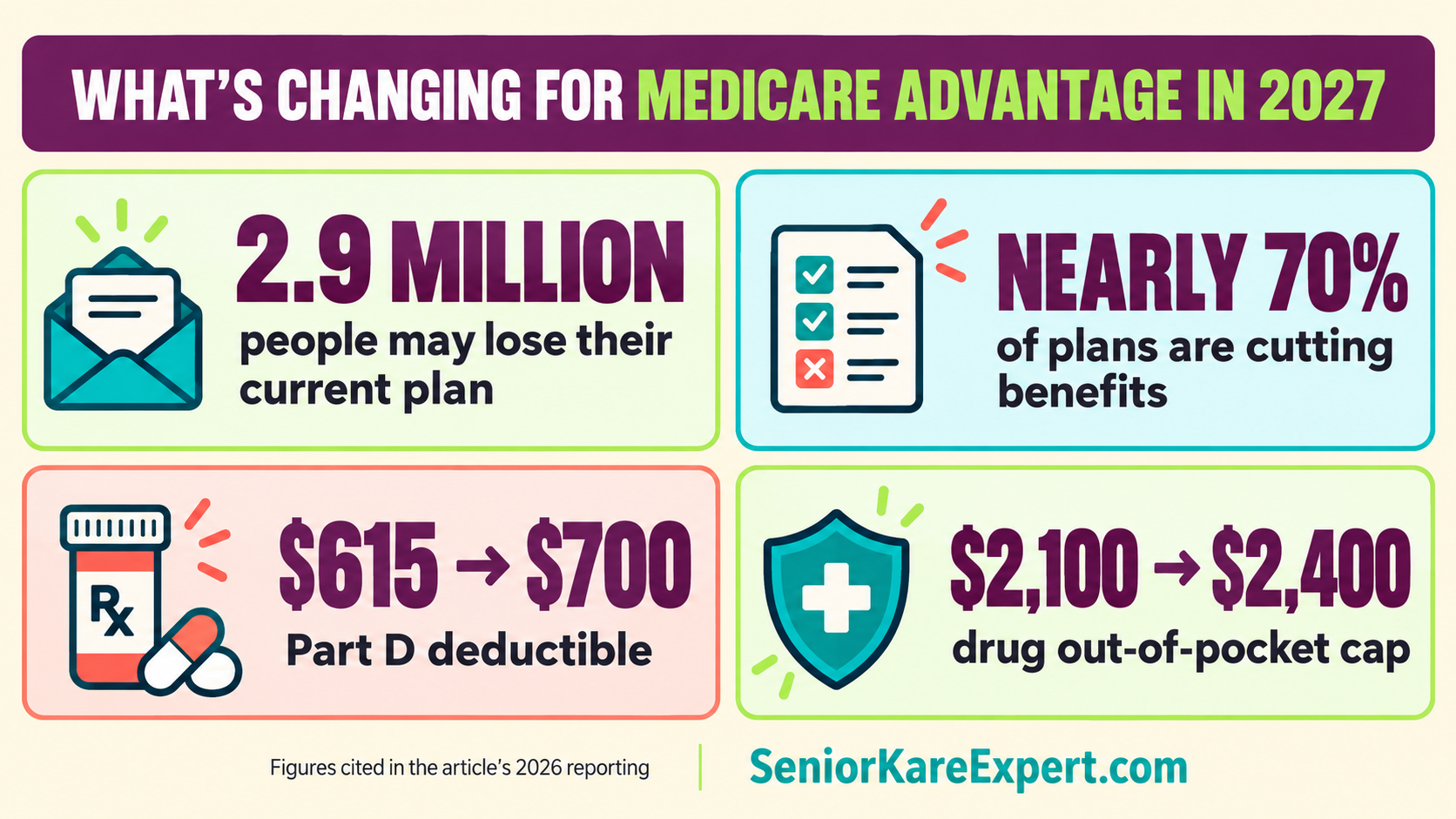
New reporting out this month found that roughly 2.9 million Medicare Advantage members nationwide are being forced off their current plan for 2027 — about 1 in 10 people enrolled in Medicare Advantage. Humana is exiting markets for the second year in a row, affecting 600,000 members. In Vermont, 92 percent of Medicare Advantage policyholders have to find something new. Twelve states have more than 20 percent of their enrollees losing coverage outright, and rural counties are getting hit hardest, with the fewest replacement options to choose from.
If your parent’s letter isn’t a cancellation notice, that doesn’t mean nothing changed. Close to 70 percent of Medicare Advantage plans are cutting benefits for 2027 even for the people who get to keep them — higher specialist copays, thinner drug coverage, new restrictions. Part D’s deductible is rising from $615 to $700. The out-of-pocket cap on drug costs is going up too, from $2,100 to $2,400. And the standard Part B premium is expected to climb from $202.90 a month to around $209.50.
None of this shows up as a headline your parent will stumble across. It shows up as a letter, or worse, as a surprise at the pharmacy counter in February.
Why this year is different
Every fall, Medicare has an open enrollment period, and every fall, most families ignore it because “the plan’s been fine.” The difference this year is that “fine” isn’t a safe assumption anymore. Insurers are pulling out of markets because of what they’re calling financial pressure and policy uncertainty, and the fallout is landing squarely on the people least equipped to absorb a scramble: seniors managing multiple conditions, on fixed incomes, who built a relationship with a specific doctor over years.
I read through a family’s account of exactly this scenario recently. An adult daughter got a call that her mother had been disenrolled from her plan days earlier, effective immediately, over a technicality in the plan’s contract. She spent hours on the phone, transferred from one person to another to another, while her mother’s ongoing treatments went uncovered because the paperwork hadn’t caught up. She wrote that she felt like she had nowhere to turn. That’s not a rare story this year. That’s the story a lot of families are about to live through if nobody opens the envelope in time.
Another family, in a piece covering Medicare Advantage complaints, described watching her 92-year-old mother get denied coverage for rehab after repeated hospitalizations. Her mother grew weaker each time. Her daughter put it plainly: these insurance companies don’t seem to understand how their decisions land on people who are a lot older. That’s not an exaggeration born of frustration. It’s the actual mechanism by which a coverage decision becomes a health decision.
What actually changes if your parent loses their plan
If your parent’s plan is one of the ones being discontinued, they’re not without coverage — but the options need to be chosen deliberately, not by default:
They can enroll in a different Medicare Advantage plan available in their area, if one exists and covers their doctors and medications.
They can return to Original Medicare (Parts A and B) and add a standalone Part D drug plan.
They also should look into a Medigap supplemental policy, which in this situation often comes with guaranteed-issue protections they wouldn’t normally have outside of enrollment windows.
If nobody chooses, your parent typically defaults into Original Medicare with no drug coverage at all — which is its own kind of gap, particularly if they take anything expensive. NOTE: This will come with a lifetime penalty for no Rx Drug coverage.
The Risk of Not Making A Decision
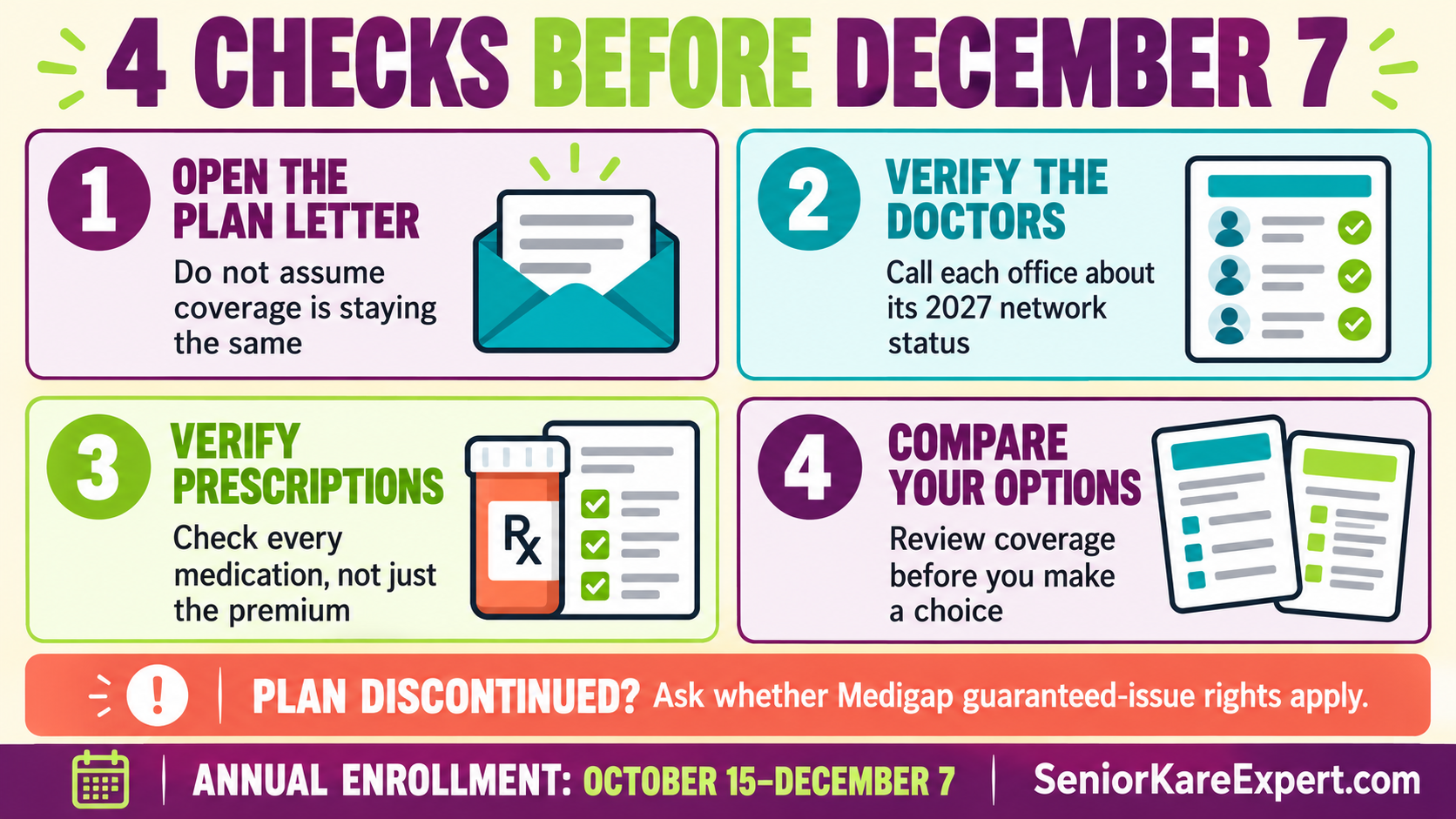
There’s also a network risk that has nothing to do with cancellation: even a plan that isn’t going away can drop an individual doctor mid-year. If your parent is on an HMO plan, losing an in-network doctor usually means finding a new one inside the network, full stop. On a PPO, they can typically keep seeing that doctor, but the cost jumps — sometimes from a flat $10 copay to 50% coinsurance. Either way, it’s worth calling the doctor’s office directly and asking whether they’re staying in-network for 2027, rather than assuming.
The Annual Enrollment Period runs October 15 through December 7, and for anyone losing a plan outright, there’s a longer Special Enrollment Period that extends through the end of February. Here’s the version of this I’d actually tell a friend to do this week, not the version that sounds responsible but never happens:
Open every piece of mail from the insurance company the moment it arrives, and don’t assume you already know what it says. Insurers are required to notify members of a plan termination by September 30, so if that letter is coming, it’s likely already sitting somewhere in your parent’s mail.
Don’t just compare the premium. Compare whether your parent’s actual doctors and prescriptions are covered under any plan you’re considering — the premium is only one part of what determines whether the plan will work well for them.
You can also work with an independent Medicare broker who can help compare plans based on doctors, prescriptions, costs, and coverage needs. Andrea Coles, founder of Senior Health Professionals, is someone I recommend to clients regularly, helps Medicare beneficiaries and their families across more than 30 states.
“Just because a plan worked well this year doesn’t mean it will work the same way next year,” Coles says. “Review your doctors, prescriptions, copays, and benefits before making a decision. Now, if benefits like dental, vision, hearing, or other coverage have been reduced, ancillary plans may help fill some of those gaps for a relatively small premium. Some of these plans do have health questions, so it’s worth looking at them while you can still qualify.”
If you’re the adult child managing this from another city, set one calendar reminder now for the week of October 15, and one for early December, so this doesn’t slip past you the way it slips past almost everyone.
This isn’t paperwork. It’s continuity of care.
It’s tempting to file this whole topic under “annoying insurance admin” and let your parent handle it, or not handle it. But the actual stakes are whether your parent keeps the doctor who knows their history, whether a medication that’s been working keeps being covered, and whether a plan cancellation turns into a coverage gap during a month when it matters. Families who’ve navigated a real financial squeeze around care costs before know this pattern well — it rarely announces itself as a crisis. It shows up quietly, in a letter, and becomes a crisis three months later if nobody opened it. I’ve written before about how families in Texas actually piece together the funding for senior care, and Medicare is almost always one piece of a larger puzzle, not the whole answer — which is exactly why it’s worth getting right rather than leaving on autopilot.
And if you’re the one who ends up doing this legwork on top of everything else you’re already carrying for your parent, that’s worth naming too. Feeling exhausted by one more system to manage doesn’t mean you’re failing at any of this. I’ve written more on why asking for help with an aging parent isn’t a failure — the same is true here. Getting SHIP on the phone isn’t giving up on handling it yourself. It’s handling it well.
Open the letter. Make the call. Do it before the mail pile gets any taller.
Frequently Asked Questions
How do I know if my parent’s Medicare Advantage plan is actually going away in 2027?
The first thing to know is that plan changes do not always arrive in dramatic language. In many cases, the notice looks routine and can be easy to miss. Medicare Advantage insurers typically send an Annual Notice of Change, often called the ANOC, and in some cases a separate notice if a plan is being discontinued, merged, or significantly changed for the coming year. If your parent’s plan is disappearing in 2027, that information is usually buried in official plan mailings sent in the fall, not in a brightly labeled “urgent” packet. Start by gathering every piece of mail from the plan and looking for phrases such as “your plan will not be offered,” “coverage will end on December 31,” “you will be moved to another plan,” or “benefits and provider access are changing.” If your parent uses email, check the online member portal and email inbox as well. You can also call the plan directly and ask a very specific question: “Will this exact plan still be available in my parent’s ZIP code for 2027?” That wording matters because a company may still offer Medicare Advantage plans generally, while eliminating the specific plan your parent has now. It is also wise to confirm the plan’s status through Medicare’s Plan Finder or by calling 1-800-MEDICARE. If the plan is ending, your parent may be automatically enrolled into another plan from the same insurer in some situations, but that does not mean the replacement is a good fit. Automatic enrollment can create a false sense of security if no one checks whether doctors, medications, out-of-pocket costs, and extra benefits still match your parent’s needs. The safest approach is to assume nothing and verify everything before the end of the annual enrollment period.What should I review first if my parent’s current Medicare Advantage plan is being terminated?
If the current plan is ending, the top priorities are doctors, drugs, costs, and timing. Begin with your parent’s primary care doctor, specialists, preferred hospital system, and regular prescriptions. A replacement plan that looks similar on paper can still have a narrower provider network, different referral rules, higher drug copays, or a different maximum out-of-pocket limit. For many families, the most expensive mistake is focusing on the monthly premium and overlooking the total cost of care if your parent actually uses services frequently. Make a simple checklist. Write down every current doctor and facility your parent uses, every prescription including dosage and pharmacy, and any ongoing treatments such as physical therapy, oncology care, dialysis, infusion services, or home health. Then compare that list against any new plan being considered. Ask whether each doctor is in network for 2027, whether the hospital is included, whether prior authorization rules have changed, and whether each medication is covered on the formulary. Even a medication that remains covered could move to a different tier and become much more expensive. Also review dental, vision, hearing, transportation, over-the-counter allowances, and supplemental benefits carefully. These extras are often heavily marketed, but they should never outweigh core medical access and prescription affordability. Finally, look at the new plan’s deductible, copays for specialists, inpatient hospital cost-sharing, skilled nursing coverage, and annual maximum out-of-pocket amount. If your parent has chronic conditions, these details can matter far more than a $0 premium. The best first review is not “Is this plan cheap?” but “Will this plan still work for how my parent actually gets care?”If my parent’s plan disappears, can they switch to another Medicare Advantage plan or go back to Original Medicare?
Yes, in most cases your parent will have options, but the timing and consequences deserve close attention. When a Medicare Advantage plan is discontinued, members generally have the opportunity during the Annual Enrollment Period to choose another Medicare Advantage plan or return to Original Medicare for the new year. Depending on the circumstances, there may also be a Special Enrollment Period connected to the plan termination. That gives your parent a pathway to make a change, but it does not automatically solve issues like provider access or supplemental coverage. Switching to another Medicare Advantage plan may be the simplest path if your parent wants to keep all-in-one coverage with medical, hospital, and usually drug benefits bundled together. However, each plan has its own network, prior authorization policies, cost-sharing structure, and formulary, so “another plan” is not interchangeable with the current one. If your parent travels often, lives in multiple states during the year, or relies on a highly specific group of specialists, compare alternatives very carefully before enrolling. Going back to Original Medicare is also possible, but families often overlook the related question of Medigap. Original Medicare does not include an out-of-pocket maximum the way Medicare Advantage plans do, so many beneficiaries want a Medicare Supplement plan to help with costs. The challenge is that in many states, enrolling in a Medigap plan after leaving Medicare Advantage can involve medical underwriting unless your parent qualifies for a guaranteed issue right. That means a supplement may cost more or, in some cases, may not be available on the most favorable terms. In addition, if your parent returns to Original Medicare, they may need to enroll in a separate Part D prescription drug plan. The decision is doable, but it should be made with a clear understanding of the financial tradeoffs and enrollment rules.What mistakes do families make when they get one of these Medicare plan notices?
The biggest mistake is assuming the notice is routine and putting it aside. Insurance mail often blends into everything else, and many seniors are used to receiving frequent plan updates that seem administrative rather than urgent. But when a plan is being discontinued or substantially changed, delay can shrink the time available to compare options thoughtfully. By the time a family realizes something important was buried in the paperwork, they may be rushing into a new plan without checking the details that matter most. Another common mistake is trusting automatic enrollment without reviewing the replacement plan. If an insurer moves your parent into another plan, that new plan might not include the same doctors, drug coverage, or cost-sharing protections. Families also tend to focus too heavily on premiums and extra benefits while overlooking provider networks, prior authorization rules, specialist copays, rehabilitation coverage, and the annual out-of-pocket maximum. Those overlooked details often determine whether the plan feels manageable or financially stressful once care is needed. A third mistake is failing to verify information directly with providers and the plan. A doctor’s office may say they “take Medicare,” but that does not always mean they are in network for a specific Medicare Advantage plan. Likewise, a drug being “covered” does not guarantee the same price or utilization rules. It is also a mistake not to document conversations. When you call a plan, write down the date, representative name, and what was confirmed. Finally, many families wait too long to ask for help. A licensed Medicare broker, State Health Insurance Assistance Program counselor, or Medicare itself can help compare options, but they are most useful before deadlines are looming, not after enrollment windows close.What is the best step-by-step way to help my parent avoid being caught off guard?
The best approach is to treat this like a short annual audit rather than a last-minute scramble. First, collect all mail and notices from the current plan, especially anything labeled Annual Notice of Change or coverage changes for 2027. Second, confirm whether the exact plan will continue next year, be modified, or end entirely. Third, create a care profile for your parent: current doctors, specialists, hospitals, prescriptions, preferred pharmacy, and expected healthcare needs for the year ahead. If your parent has upcoming surgeries, expensive medications, or regular specialist visits, those should be front and center in the comparison process. Next, compare available plans side by side. Look beyond the headline premium and evaluate network participation, drug coverage, prior authorization requirements, specialist copays, hospitalization costs, and the annual maximum out-of-pocket limit. If your parent may consider returning to Original Medicare, also research Medigap availability and the cost of a separate Part D plan before making that move. This is where many families benefit from a second set of eyes, especially if the plan options are numerous or your parent’s medical situation is complex. After narrowing the choices, confirm details directly with both the plan and providers. Verify that each important doctor is in network for 2027, each medication is covered at an affordable tier, and each major facility your parent uses is included. Then make the enrollment decision well before the deadline so there is time to fix errors, print confirmation materials, and set up the new member account if needed. Finally, once the new plan is chosen, help your parent organize all plan documents in one place and watch for the new ID card, formulary, and provider directory. The goal is not just to pick a plan, but to make sure your parent starts the year knowing exactly how to use it.
Stacey Eisenberg’s connection to senior care didn’t start with a job posting. It started at age three, in the activity room of a Coney Island nursing home where her mother worked. Growing up inside nursing homes in the 1970s and ’80s, she witnessed what genuine caregiving looked like before the industry got complicated by paperwork, liability, and the relentless pressure to do more with less. That became the standard she has spent her career trying to restore — bringing the Care back to caregiving.
By 13, Stacey had her first official job in senior care. Over the past four decades, she has worked across virtually every setting: nursing homes, assisted living communities, memory care residences, rehab centers, hospitals, and independent living. She served as Director of Fun for nearly 300 independently living seniors, coordinating daily events, activities, and outings.
Today, Stacey and her husband Bryan own A Place At Home – North Austin, an award-winning home care agency serving families across Round Rock, Georgetown, Cedar Park, Leander, Hutto, and surrounding Central Texas communities. Their agency has been voted Best Home Care Agency in Round Rock two years running (2024 and 2025) and received national recognition from Activated Insights as both a Best of Home Care Provider of Choice and Employer of Choice in 2025.
Stacey is a trained recreation therapist and serves as a Community Educator for the Alzheimer’s Association: Capital of Texas chapter. She serves as Treasurer on the Adult Protective Services Advisory Board and as Community Awareness Chair for the Aging Services Council. She co-facilitates the Williamson County Health Resource networking group and is a member of the National Aging in Place Coalition. In 2025, she was recognized as a finalist in the Woman of Wilco awards and is the creator of Peter’s Memory Beads, a passion project to raise funds for the Alzheimer’s Association.
Her expertise has been featured in U.S. News and World Report, AARP, and Care.com.