
You wake up already exhausted. Sleep doesn’t restore you the way it used to. It’s been years since you took a real day off, and most days you feel adrift, alone in a sea of day-to-day survival, so absorbed in what your parent needs that you’ve genuinely forgotten what it’s like to just be you. Some days it feels like a truck ran you over, backed up, and hit you again. You’re just done. Toast. And underneath all of it sits the guilt: you feel resentful, and then you feel guilty for feeling resentful. You want out, and then you’re overcome with guilt for wanting it.
If that paragraph landed a little too close, I want you to know something before you read another word: none of that makes you a bad daughter or son. It makes you a family caregiver in America in 2026. And this week, for the first time, someone actually put a number on what you’re carrying.
The Number Nobody Expected
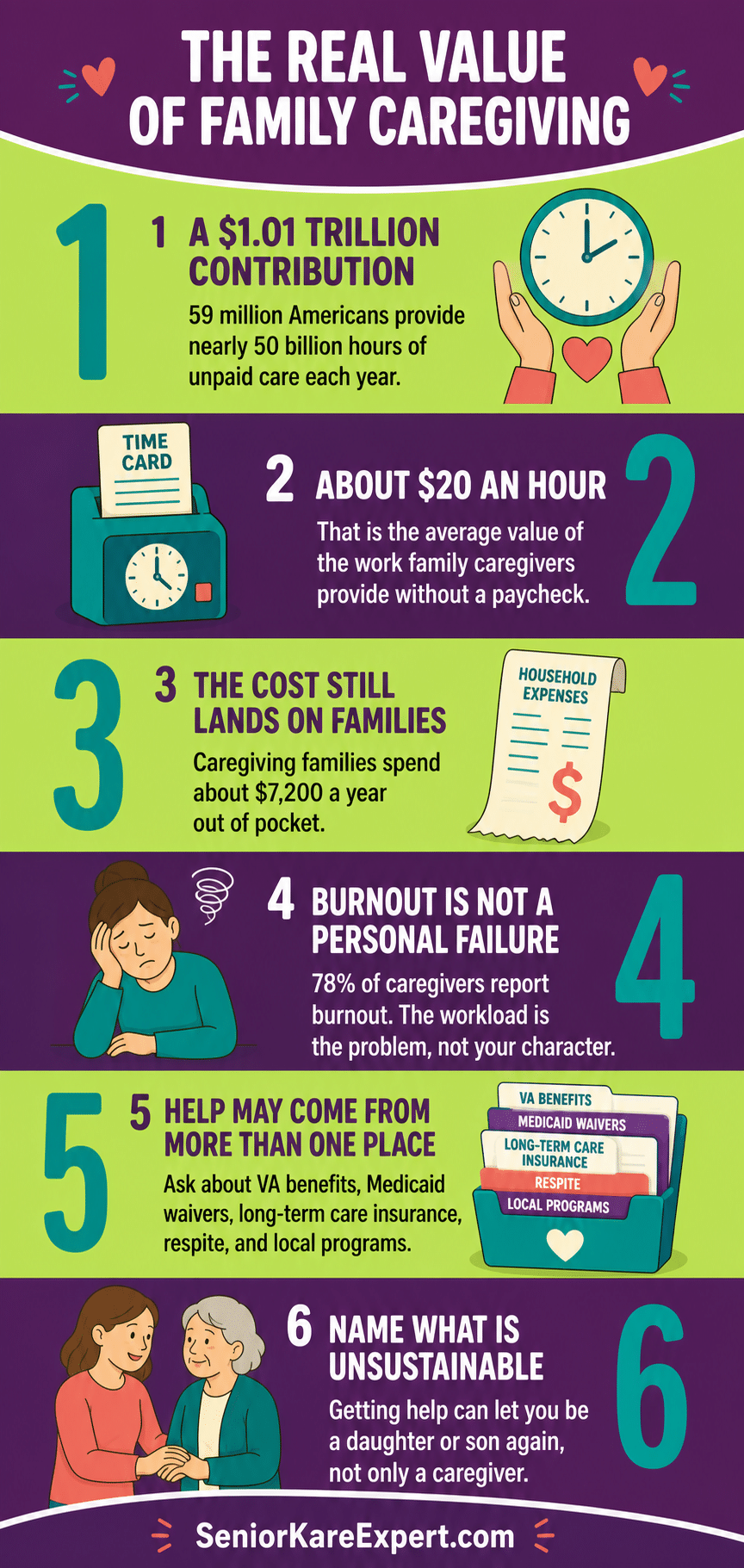
AARP released new research putting the economic value of family caregiving at $1.01 trillion a year. That’s 59 million Americans providing nearly 50 billion hours of unpaid care, valued at just over $20 an hour on average. To put that in context: it’s more than all Medicaid spending in the country, combined, at every level of government. It’s nearly double what Americans spend out of pocket on health care.
I read that number and had two reactions at once. The first was relief: finally, someone measured it. Finally, the word “just” comes off the front of “just a caregiver.” The second reaction was harder to sit with. A trillion-dollar valuation doesn’t pay your electric bill. It doesn’t give you Tuesday afternoon back. It doesn’t show up as a check.
That’s the gap so many of you are living in right now. You’re being told your work has never mattered more, in the same year it’s never cost you more.
Why Being Valued Doesn’t Feel Like Being Supported
Here’s what’s landing on families at the same time as that AARP number. New data from A Place for Mom’s 2026 caregiver research found that 78% of caregivers report feeling burned out, many of them weekly or daily, and 68% say caregiving has created real financial strain. Almost 40% say their social life has gotten measurably worse. Half report their mental health has taken a hit.
And the paid help that’s supposed to be the pressure release valve is getting harder to lean on, not easier. Medicare finalized a 6.4% cut to aggregate home health payments for 2026, largely to recoup what CMS says were overpayments from 2020 through 2024. Whatever the accounting reason, the practical effect for families is the same. Agencies are operating on thinner margins, and there’s less room in the system to absorb your parent’s care.
It’s no coincidence that A Place for Mom also found 45% of families who stopped paid home care said they simply couldn’t afford to keep going. Not that it wasn’t working. Not that Mom didn’t need it anymore. The math just stopped working.
I’ve written before about the emotional storm that impacts caregivers: the stress, the guilt, the isolation that shows up long before anyone else notices something’s wrong. What’s different this year is that the emotional storm now has a financial one sitting right on top of it.
The Math You’re Actually Doing at Midnight
You already know the numbers I’m about to give you, because you’re living them. Recent research on the cost of caring for aging parents put the average family’s out-of-pocket spending at $7,200 a year: transportation, medications, supplies, the small things that add up before you’ve hired anyone at all. Private in-home aides run $25 to $40 an hour, which is $50,000 to $80,000 a year for full-time coverage most families can’t get near. And researchers at Columbia University found that caregivers who start young can face up to a 90% deficit in their own retirement savings by age 65, compared to people who never took on caregiving. For women specifically, the lifetime cost (lost wages, lost Social Security, lost retirement contributions) runs between roughly $295,000 and $324,000. (You can see the fuller breakdown of these figures here.)
You are not imagining the squeeze. It’s real, it’s documented, and it’s getting tighter this year, not looser.
If you’re in Texas and trying to figure out where the money for care is actually supposed to come from, I put together a plain-language breakdown of how families here actually pay for senior care: private pay, VA benefits, Medicaid waivers, and the combinations most families end up using because no single option covers it all.
What Actually Helps (Not the Advice You’ve Already Heard)
I’m not going to tell you to practice self-care. If you’re reading this at midnight after finally getting your parent settled, you already know self-care exists. What you need is permission and a next step, not another item on the list.
So here’s the permission first: needing help is not the same as failing. I wrote a piece a while back called Why Getting Help for an Aging Parent Isn’t Failing Them, and the core of it still holds. Loving someone and knowing how to provide skilled, sustained care for them are two different skills. Bringing in help doesn’t replace your relationship with your parent. It’s often what lets you go back to being their daughter or son instead of only their caregiver.
Here’s the next step. Before you decide you can’t afford help, find out what you actually qualify for, because most families are leaving money on the table they don’t know exists. VA Aid and Attendance, Medicaid waiver programs, and long-term care insurance can often be combined rather than used one at a time. A single conversation with someone who knows the local funding landscape can change the math more than another month of white-knuckling it alone.
And if the caregiving load has quietly become unsustainable, not someday, but now, that’s worth naming out loud to someone, today. Not because you’ve failed. Because a trillion dollars’ worth of labor deserves more than a number. It deserves relief.
Why does helping my mom feel so exhausting when I love her and want to do the right thing?
Because love does not cancel out strain. You can care deeply about your mom and still feel physically, emotionally, and mentally depleted by the ongoing demands of caregiving. When you are constantly anticipating needs, solving problems, managing appointments, handling medications, watching for emergencies, and carrying the emotional weight of someone else's decline or dependence, your nervous system rarely gets to fully power down. That kind of chronic stress builds quietly over time. It can show up as exhaustion that sleep does not fix, irritability, brain fog, sadness, resentment, or the sense that you are surviving rather than living. Many family caregivers assume that if they are struggling, it must mean they are not strong enough, grateful enough, or devoted enough. In reality, it usually means they have been doing too much for too long with too little support. The work is not just time-consuming. It is emotionally loaded. You may be grieving the relationship you used to have with your mom while also trying to meet the needs of the relationship you have now. That tension is draining. It is also common to feel isolated, especially if siblings, extended family, or friends do not fully understand what your daily reality looks like. If helping your mom feels like it is draining you dry, that is not proof that you are failing. It is evidence that caregiving has real limits and real costs. Recognizing that truth is often the first step toward getting practical support, setting boundaries, and finding a way to care without disappearing from your own life completely.Is it normal to feel resentful and then guilty for feeling resentful?
Yes. Extremely normal. Resentment and guilt are two of the most common emotional patterns in caregiving, and they often feed each other. Resentment tends to show up when your needs have been pushed aside for so long that part of you is internally protesting. You may resent the constant interruptions, the loss of freedom, the financial pressure, the lack of help from others, or the feeling that your identity has narrowed to what your parent needs from you. Then guilt arrives because you believe a good son or daughter should not feel that way. But feelings are not moral failures. They are information. Resentment often signals overload, unresolved expectations, unclear boundaries, or unfair distribution of responsibility. Guilt, on the other hand, can come from deeply ingrained beliefs about duty, family roles, and self-sacrifice. Many adult children were taught, directly or indirectly, that putting themselves first is selfish, even when they are running on empty. That belief can keep people trapped in patterns that are unsustainable. The healthier question is not, “How do I stop feeling resentful?” but rather, “What is this resentment trying to tell me?” Maybe you need regular time off. Maybe decisions need to be shared. Maybe your mom needs more outside support than one person can realistically provide. Maybe your standard for what you should be able to do alone is simply impossible. When you listen to the message underneath the resentment instead of shaming yourself for having it, you can start making changes that protect both your well-being and the quality of care you provide.How can I tell if I am burned out from caregiving and not just having a hard week?
Caregiver burnout usually goes beyond ordinary fatigue. It tends to be persistent, cumulative, and difficult to reverse with a single good night's sleep or a short break. Common signs include waking up exhausted, feeling emotionally numb or unusually tearful, losing patience more quickly, struggling to focus, feeling detached from your own life, neglecting your health, and experiencing a sense of dread about the next demand before the day even begins. Some people notice physical symptoms too, such as headaches, body aches, digestive issues, disrupted sleep, frequent illness, or the sensation that their body is constantly bracing for impact. Another major sign is identity erosion. If your world has become so centered on your mom's needs that you cannot remember what you enjoy, what restores you, or who you are outside of caregiving, that is more than a rough patch. It is a warning sign that the role has consumed too much of your emotional bandwidth. Burnout can also show up as hopelessness, withdrawal from friends, increased use of food, alcohol, or scrolling to numb out, or fantasies of escape that come with intense shame. If this sounds familiar, it is important not to minimize it. Burnout affects judgment, patience, health, and resilience. It can increase the risk of depression and anxiety, and it can make caregiving less safe and less sustainable over time. Taking burnout seriously is not selfish or dramatic. It is responsible. The sooner you acknowledge it, the sooner you can explore practical steps like respite care, support groups, medical check-ins for yourself, therapy, shared caregiving plans, and clearer boundaries around what you can and cannot continue to do alone.What can I do if I feel like I have lost myself while taking care of my mom?
Start small, but start deliberately. Losing yourself in caregiving does not usually happen all at once, and reclaiming yourself rarely happens in one dramatic move either. It happens through repeated acts of remembering that you are a person, not just a role. That might mean protecting 15 minutes a day that belong only to you, reaching back out to a friend you have drifted from, returning to an old hobby in a reduced form, taking a walk without multitasking, journaling what you actually feel instead of what you think you should feel, or making one appointment for your own health that you have been postponing. It also helps to rebuild your identity in language. Instead of only asking, “What does my mom need today?” ask, “What do I need today to stay steady?” Instead of defining a good day solely by whether everything went smoothly for her, include your own well-being in the equation. This is not self-centered. It is essential. Caregiving becomes dangerous when one person's needs count and the other person's do not. On a practical level, regaining yourself often requires reducing the total load, not just coping better with the same impossible load. Look for tasks that can be delegated, delayed, automated, shared, or outsourced. Consider whether there are community services, adult day programs, home care aides, meal delivery, transportation help, or care management resources that could lighten the burden. If family dynamics are part of the problem, a structured conversation with siblings or a professional mediator can help clarify responsibilities. Reclaiming yourself is not abandoning your mom. It is refusing to vanish in the process of loving her.Does needing help mean I am failing my mom or not doing enough?
No. Needing help means you are human. Family caregiving is often treated like an invisible obligation that should be managed quietly, competently, and without complaint. That expectation is unrealistic and harmful. No one is meant to provide endless emotional, logistical, and physical care without support. In fact, asking for help is often one of the clearest signs that you are taking the situation seriously. It means you understand that good care depends on sustainability, not martyrdom. Many adult children measure themselves against an impossible standard: be available all the time, never feel frustrated, keep every promise, protect your parent from discomfort, and somehow preserve your own life in the margins. When that standard inevitably collapses, they interpret the collapse as personal failure rather than proof that the standard itself was flawed. The truth is that support systems exist because caregiving is bigger than one person. Medical professionals, social workers, elder care services, therapists, respite providers, faith communities, neighbors, and other family members can all be part of the solution. If asking for help feels uncomfortable, try reframing it. You are not handing off love. You are building a structure that allows love to continue without crushing you. Your mom may need care, but you need care too. The strongest caregiving plans are not built on constant self-sacrifice. They are built on honesty, support, boundaries, and the recognition that your life matters every bit as much as the care you give.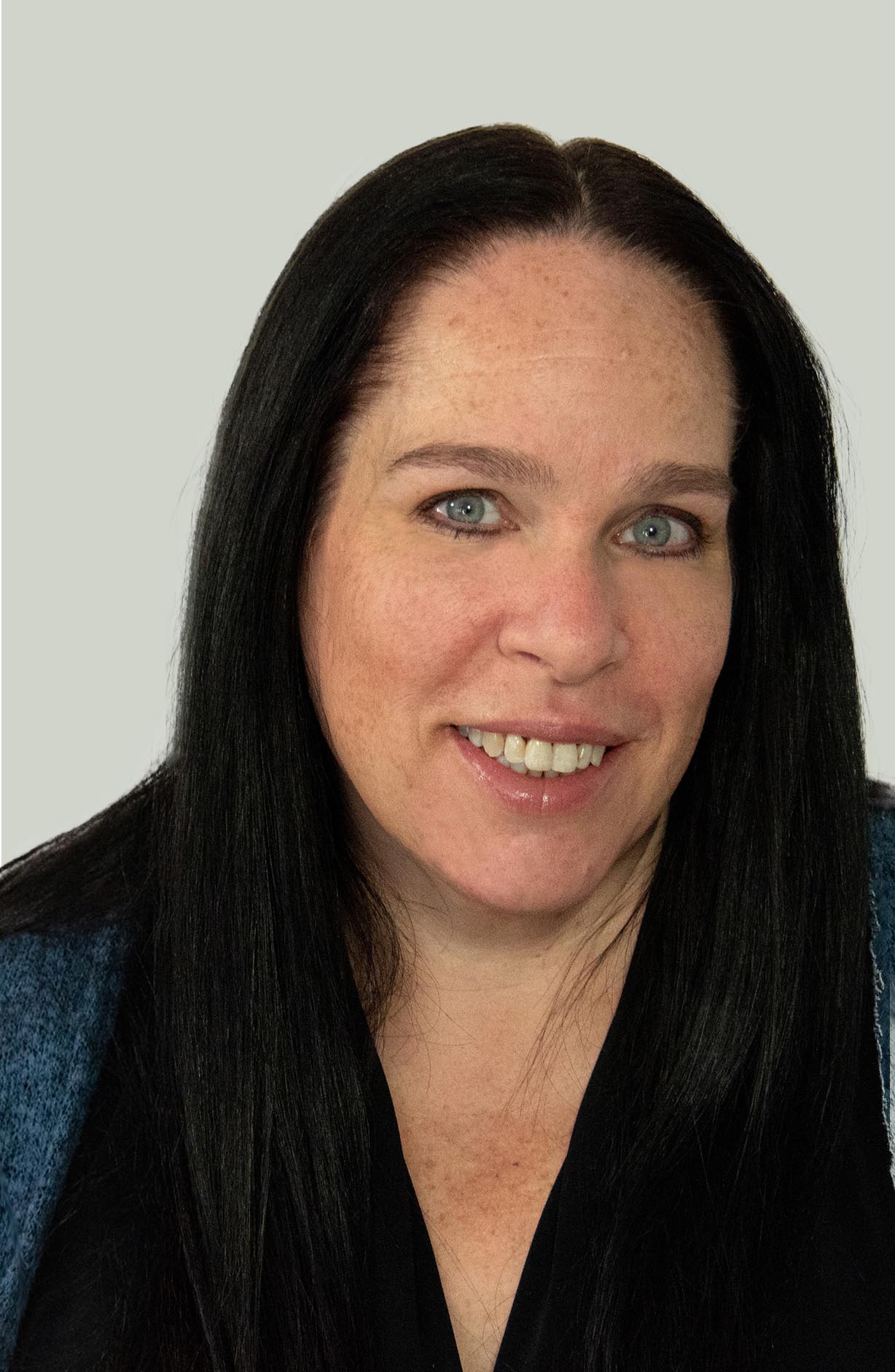
Stacey Eisenberg’s connection to senior care didn’t start with a job posting. It started at age three, in the activity room of a Coney Island nursing home where her mother worked. Growing up inside nursing homes in the 1970s and ’80s, she witnessed what genuine caregiving looked like before the industry got complicated by paperwork, liability, and the relentless pressure to do more with less. That became the standard she has spent her career trying to restore — bringing the Care back to caregiving.
By 13, Stacey had her first official job in senior care. Over the past four decades, she has worked across virtually every setting: nursing homes, assisted living communities, memory care residences, rehab centers, hospitals, and independent living. She served as Director of Fun for nearly 300 independently living seniors, coordinating daily events, activities, and outings.
Today, Stacey and her husband Bryan own A Place At Home – North Austin, an award-winning home care agency serving families across Round Rock, Georgetown, Cedar Park, Leander, Hutto, and surrounding Central Texas communities. Their agency has been voted Best Home Care Agency in Round Rock two years running (2024 and 2025) and received national recognition from Activated Insights as both a Best of Home Care Provider of Choice and Employer of Choice in 2025.
Stacey is a trained recreation therapist and serves as a Community Educator for the Alzheimer’s Association: Capital of Texas chapter. She serves as Treasurer on the Adult Protective Services Advisory Board and as Community Awareness Chair for the Aging Services Council. She co-facilitates the Williamson County Health Resource networking group and is a member of the National Aging in Place Coalition. In 2025, she was recognized as a finalist in the Woman of Wilco awards and is the creator of Peter’s Memory Beads, a passion project to raise funds for the Alzheimer’s Association.
Her expertise has been featured in U.S. News and World Report, AARP, and Care.com.