

You assumed Medicare would be there when your parent needed help at home. Most people do. It’s the safety net you’ve paid into your whole working life, so it makes sense to think it covers whatever comes next.
Then the call comes. Mom fell, or Dad had a small stroke, or the doctor said the word “can’t” about something he used to do without thinking. And somewhere in the scramble that follows, you find out the truth: Medicare doesn’t pay for eldersitting or companionship hours at all. If what your parent actually needs is someone there most days to help with bathing, meals, medication reminders, and just being present, Medicare was never built to cover that.
I hear this from families constantly. Not “I wish someone had told me” in a vague, wistful way. I mean the specific, frustrated version: nobody told me this part.
What Medicare Actually Pays For
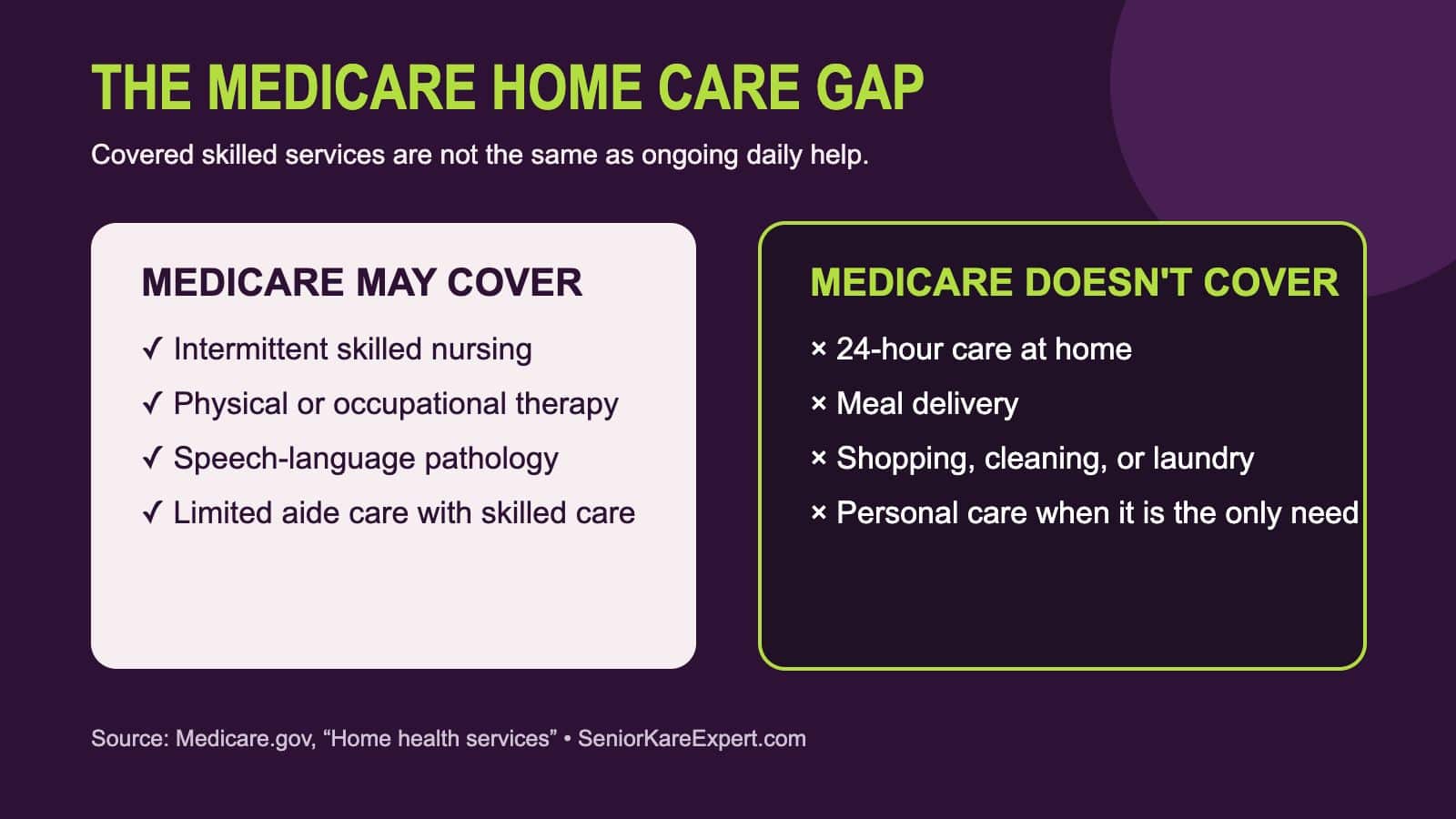
Medicare’s home health benefit is real, but it’s narrower than most families expect. It covers medically necessary part-time or intermittent skilled nursing, physical, occupational, and speech therapy, and medical social services when the eligibility conditions are met and an approved provider orders the care. The care is reviewed in 60-day certification periods, but those periods can be renewed as long as your parent continues to qualify. It was not designed to provide the ongoing daily help an aging parent may need to stay safely at home for years.
What it explicitly leaves out: 24-hour care, meal delivery, household tasks like grocery shopping and laundry, and personal care like bathing and dressing when that is the only care your parent needs. Medicare’s own explanation of the home health benefit makes the distinction clear: covered home health is part-time or intermittent skilled care, not a substitute for ongoing long-term care. That gap between what people assume and what’s actually written into the program is where most families get blindsided.
Medicaid can help fill some of that gap, but it comes with its own wall: you generally have to meet strict income and asset limits to qualify, and what’s covered varies significantly by state.
The Bill Nobody Warned You About
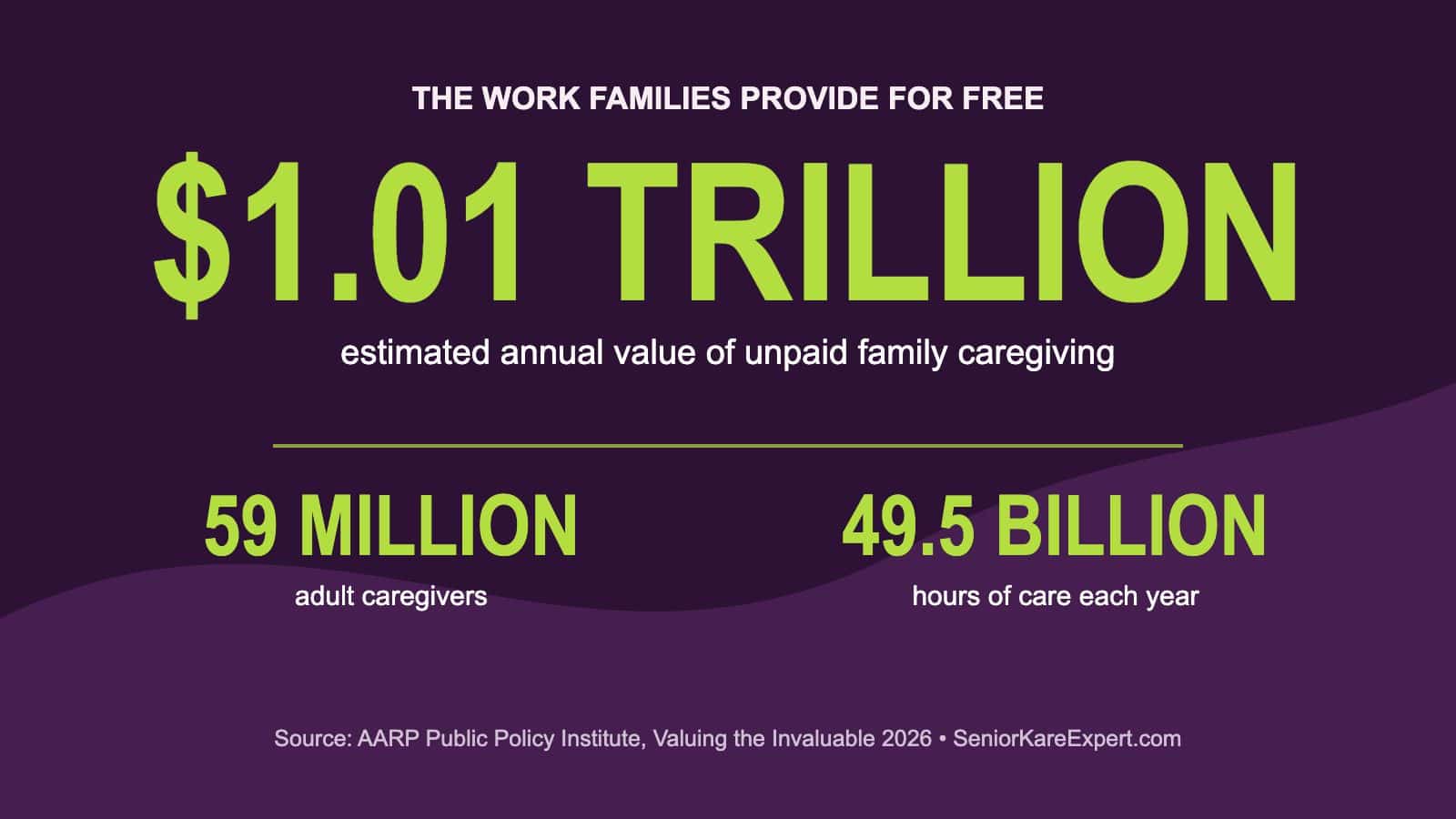
Here’s why this matters right now. AARP’s newest research puts the value of unpaid family caregiving at just over $1 trillion a year, provided by 59 million Americans logging nearly 50 billion hours of care. That’s not a future problem. That’s happening in kitchens and spare bedrooms across the country today.
A separate AARP survey found the number of Americans providing this kind of care has jumped 45% over the past decade, to roughly 63 million people, and nearly a quarter of them have gone into debt because of it. About one in three have stopped saving for their own retirement.
And A Place for Mom’s newest research on home care found that cost, not quality or trust, is the number one reason families discontinue care once they’ve started it. Forty-five percent of families who stopped professional home care said affordability was why.
I’ve watched this play out with families in ways that go well beyond a line item. Your parents have a small nest egg. Not enough to cover in-home care. And that’s all they want, to stay in the home they’ve lived in for decades. So the gap gets filled by you: you give up income, you rearrange a full-time job around it, you find yourself constantly trying to balance two lives that were never designed to fit together in the same day. Some families tell me they’ve left a career they loved and now feel tied down at home, like the life they had is simply over. Others describe being wiped out physically and emotionally in a way that doesn’t lift after a good night’s sleep, because there wasn’t a good night’s sleep.
None of that shows up on a Medicare coverage chart. But it’s the real cost of the gap.
Why the System Feels Designed to Wear You Down
That responsibility gets expensive fast if you try to handle it alone. Hire someone directly and you become their employer overnight: payroll taxes, workers’ comp, liability insurance, background checks, and scrambling for coverage the day they call in sick. I’ve broken down what that actually adds up to compared to going through an agency, and the real gap between the two is usually smaller than the hourly rate makes it look.
And even once you decide an agency is the smarter move, not every agency is the same. Plenty of them are call centers with a local mailing address, not people who actually know your family or your parent’s doctor. I’ve written about how to tell a home care agency that’s really part of your community from one that just says it is, because that difference is where the real friction lives.
VA Aid and Attendance may help eligible veterans and surviving spouses pay for care, but eligibility is tied to VA pension rules and medical need, not simply to having served. Processing times vary, and retroactive payments depend on the benefit’s effective-date rules. If your family needs time to gather documentation, filing an Intent to File may protect a potential start date while you prepare the application. The safest first step is to contact a VA-accredited Veterans Service Organization representative. Their help with VA benefit claims is always free. The lesson isn’t “don’t bother.” It’s “start before the situation becomes urgent,” because paperwork is much harder to manage in the middle of a crisis.
The One Real Exception: Medicare’s New Dementia Benefit
Here’s something I don’t say often about Medicare: it actually got better for one group of families. If your parent has a diagnosis of Alzheimer’s or another dementia, there’s a program called GUIDE, short for Guiding an Improved Dementia Experience. It’s an eight-year CMS model that began in July 2024 and runs through 2032.
If your parent is enrolled in Original Medicare Parts A and B, has a dementia diagnosis, has an unpaid caregiver, and isn’t enrolled in Medicare Advantage, hospice, PACE, or long-term nursing home care, GUIDE may pair your family with a dedicated dementia care navigator and provide caregiver education and care planning. It also includes something families almost never expect to hear from Medicare: paid respite services for eligible patients, reimbursed up to an annual cap of $2,500, adjusted for inflation, with no patient cost-sharing. The number of respite hours varies according to the type of service and its cost.
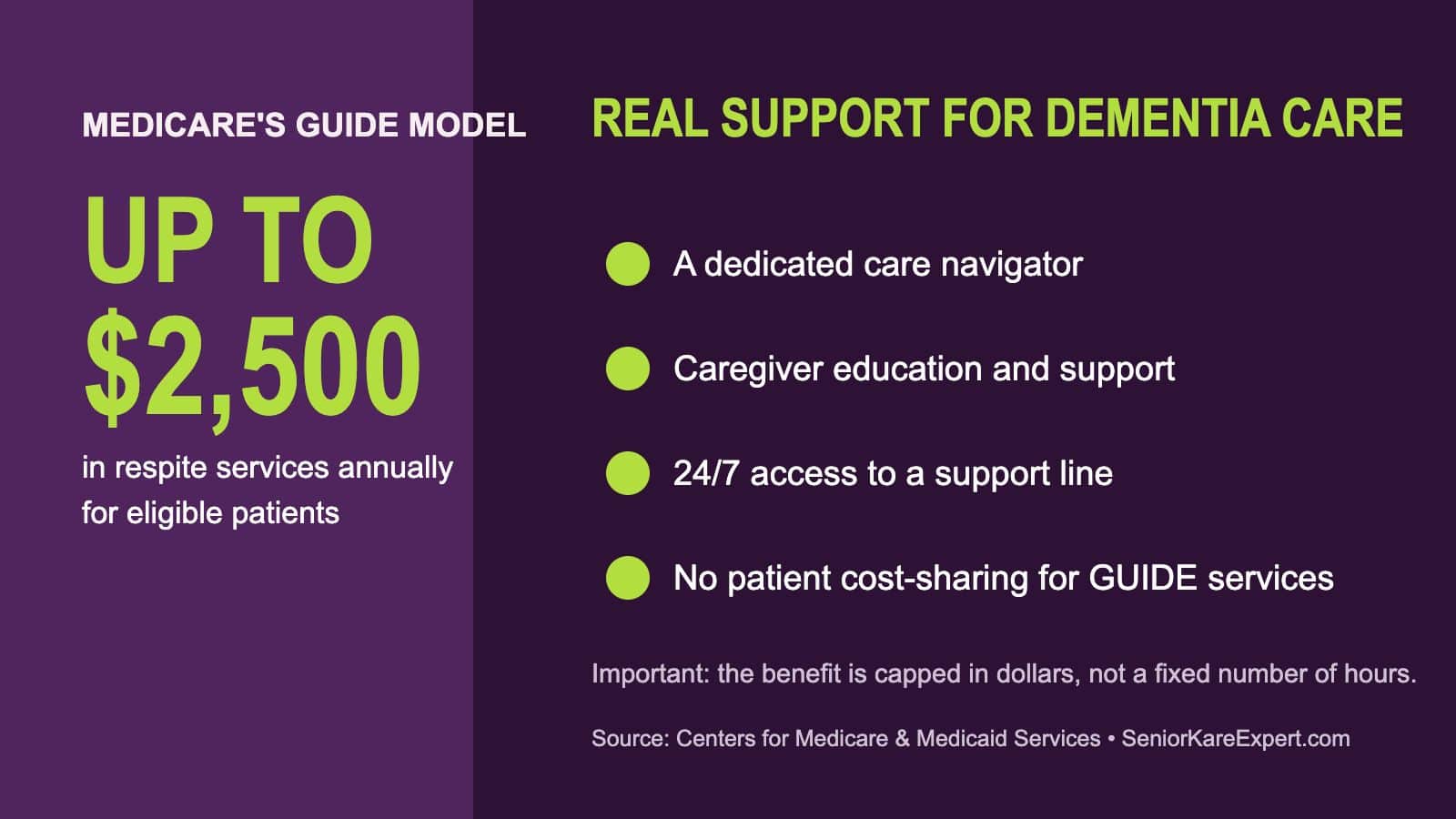
I want to be honest about what that is and isn’t. The respite benefit will not replace daily home care. But it is real money the government is now putting toward giving you a break, specifically because dementia caregiving burns people out faster than almost anything else on this list, and it didn’t exist before 2024. This is new enough that most families have never heard of it, which means many families may not know to ask about it.
If your parent has a dementia diagnosis and nobody has mentioned GUIDE to you yet, that’s the first call to make. Not the last resort. The first one. My own agency, A Place At Home – North Austin, is credentialed to provide respite care through the GUIDE program.
Where the Real Help Actually Lives
If Medicare isn’t going to cover the daily help your parent needs, here’s where to actually look:
Medicare’s GUIDE Model, if your parent has a dementia diagnosis. It’s the one place Medicare now pays for actual respite care, and it’s new enough that almost nobody asks about it.
VA benefits, if your parent or their spouse served. Aid and Attendance is underused precisely because families assume it’s not worth the wait or don’t know it exists.
Medicaid home and community-based waivers, if income and assets qualify. These vary by state, so it’s worth a real conversation with your local Area Agency on Aging rather than assuming the answer is no.
Long-term care insurance, if your parent has a policy already. Read it now, before a crisis, so you know what’s actually covered and what documentation a claim will require.
A geriatric care manager, if you’re drowning in the coordination of all of this on top of a job and a family of your own. I’ve written before about how a geriatric care manager eases the burden of navigating appointments, benefits paperwork, and financial planning that most families are doing for the first time under pressure.
If you’re still early in figuring out what kind of help your parent actually needs day to day, it’s worth reading what caregivers and home care aides actually do, including how families think through the financial side of that decision. And if the goal is helping your parent stay in their own home as long as possible, I’ve also written about what aging in place really requires to work, financially and otherwise.
What I’d Tell You to Do This Week
Don’t wait for a crisis to find out what’s covered. Call your parent’s Medicare plan and ask, in plain language, exactly what their home health benefit does and doesn’t include. If your parent has a dementia diagnosis, ask specifically about the GUIDE Model and whether a dementia care navigator has been assigned. If your parent is a veteran or a surviving spouse, check the VA pension and Aid and Attendance eligibility rules now, before the situation gets urgent. If you may qualify, submit an Intent to File or begin the application, and ask a VA-accredited VSO representative for free help. And give yourself permission to decide what you can and cannot do, and to hold that line. You don’t have to fill every gap the system leaves open. You just have to know where the gaps actually are, instead of finding out in the middle of a crisis.
That’s the whole point of a hard conversation like this one. Not to scare you. To make sure you’re not the one absorbing a cost nobody told you was coming.
Stacey Eisenberg is the owner of A Place At Home – North Austin and founder of SeniorKareExpert.com, where she helps families navigate elder care decisions with confidence and clarity.

Stacey Eisenberg’s connection to senior care didn’t start with a job posting. It started at age three, in the activity room of a Coney Island nursing home where her mother worked. Growing up inside nursing homes in the 1970s and ’80s, she witnessed what genuine caregiving looked like before the industry got complicated by paperwork, liability, and the relentless pressure to do more with less. That became the standard she has spent her career trying to restore — bringing the Care back to caregiving.
By 13, Stacey had her first official job in senior care. Over the past four decades, she has worked across virtually every setting: nursing homes, assisted living communities, memory care residences, rehab centers, hospitals, and independent living. She served as Director of Fun for nearly 300 independently living seniors, coordinating daily events, activities, and outings.
Today, Stacey and her husband Bryan own A Place At Home – North Austin, an award-winning home care agency serving families across Round Rock, Georgetown, Cedar Park, Leander, Hutto, and surrounding Central Texas communities. Their agency has been voted Best Home Care Agency in Round Rock two years running (2024 and 2025) and received national recognition from Activated Insights as both a Best of Home Care Provider of Choice and Employer of Choice in 2025.
Stacey is a trained recreation therapist and serves as a Community Educator for the Alzheimer’s Association: Capital of Texas chapter. She serves as Treasurer on the Adult Protective Services Advisory Board and as Community Awareness Chair for the Aging Services Council. She co-facilitates the Williamson County Health Resource networking group and is a member of the National Aging in Place Coalition. In 2025, she was recognized as a finalist in the Woman of Wilco awards and is the creator of Peter’s Memory Beads, a passion project to raise funds for the Alzheimer’s Association.
Her expertise has been featured in U.S. News and World Report, AARP, and Care.com.