

“It’s another no-show,” your dad says, dejected, and you don’t have time to figure out why before you have to figure out what happens next. Who checks on him this afternoon. Who is going to change his messy brief and prepare him for bed tonight? Now you’re the one dropping everything, again, to drive across town.
If that scene feels familiar, you’re not imagining that it’s gotten more common. There’s a real reason caregivers are harder to count on right now, and understanding it is the first step to actually protecting your parent from it.
Why This Is Happening More Often Right Now
Home care and home health work depends heavily on a workforce that’s currently under real strain. Immigrants make up nearly 39.8% of the nation’s home health care workforce, according to industry reporting tracking the effects of tightening immigration enforcement on caregiver staffing. As that pipeline narrows, agencies nationwide are having a harder time filling shifts, and it’s showing up in the numbers families feel directly: home health care service prices rose 10.7% in the twelve months ending June 2026, more than four times the increase in consumer prices overall.
None of that is your agency’s fault, necessarily. But it does mean the difference between a well-staffed agency and a thin one matters more this year than it did a couple of years ago, and it’s worth understanding before you’re relying on the answer in a moment of crisis.
This Isn’t Just an Inconvenience
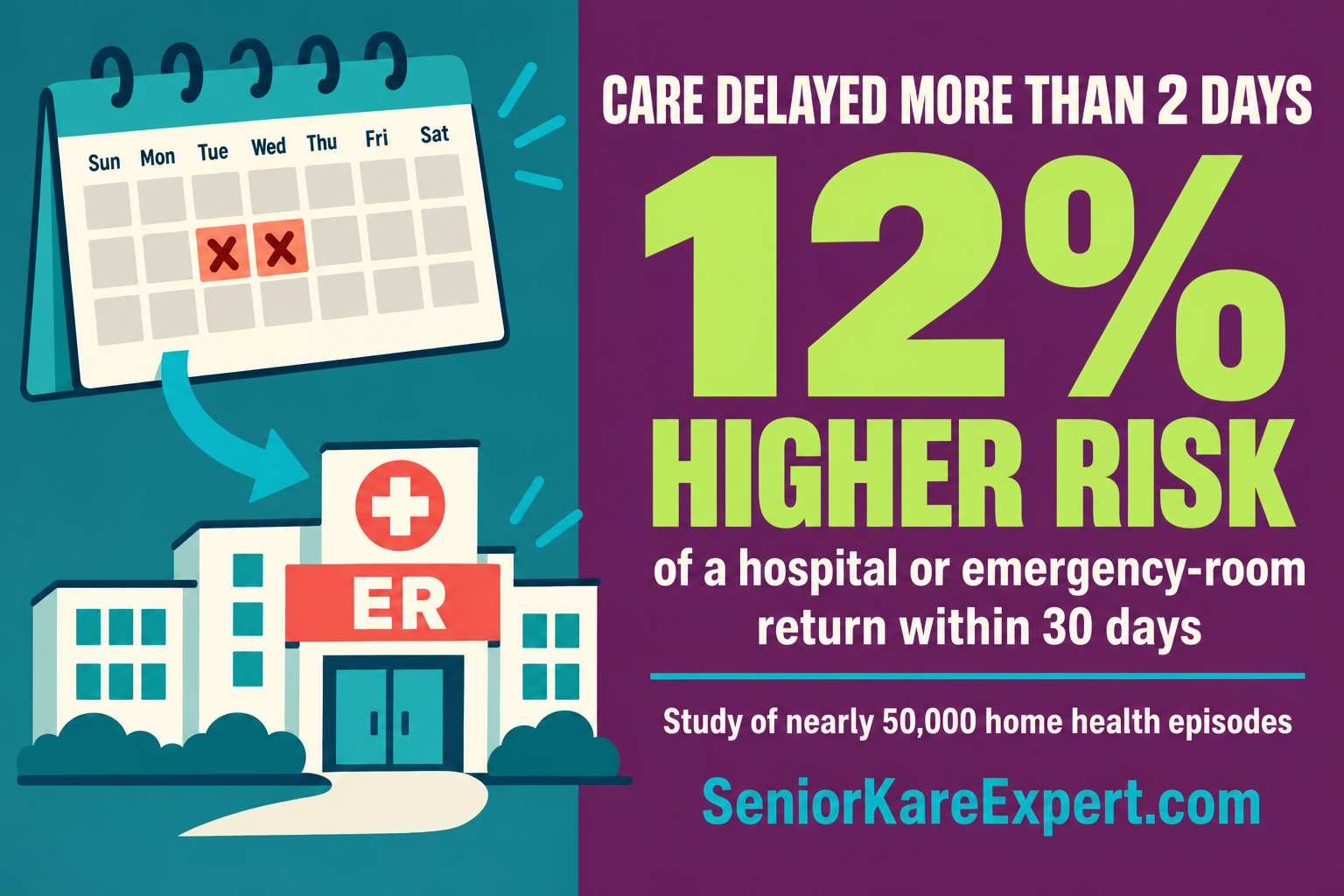
It’s tempting to treat a missed visit as an annoyance you’ll sort out by making a few calls. The research says it’s worth taking more seriously than that. A study of nearly 50,000 home health care episodes found that patients whose care was delayed more than two days after hospital discharge had a 12% higher risk of ending up back in the hospital or emergency room within 30 days. I’ve written before about the broader case for hiring home care after a hospital discharge, where nearly 20% of seniors are readmitted within 30 days of leaving the hospital in the first place. A gap in coverage during that window isn’t a scheduling hiccup. It’s a measurable increase in the odds your parent ends up back in a hospital bed.
What “Reliable” Actually Means, and How to Tell Before You Need It
One woman who’d been through a bad agency experience put it simply: “Don’t just believe the advertising.” That’s fair advice, and it’s also actionable. Reliability isn’t a slogan an agency puts on its website. It’s a set of specific practices you can ask about before you sign anything.
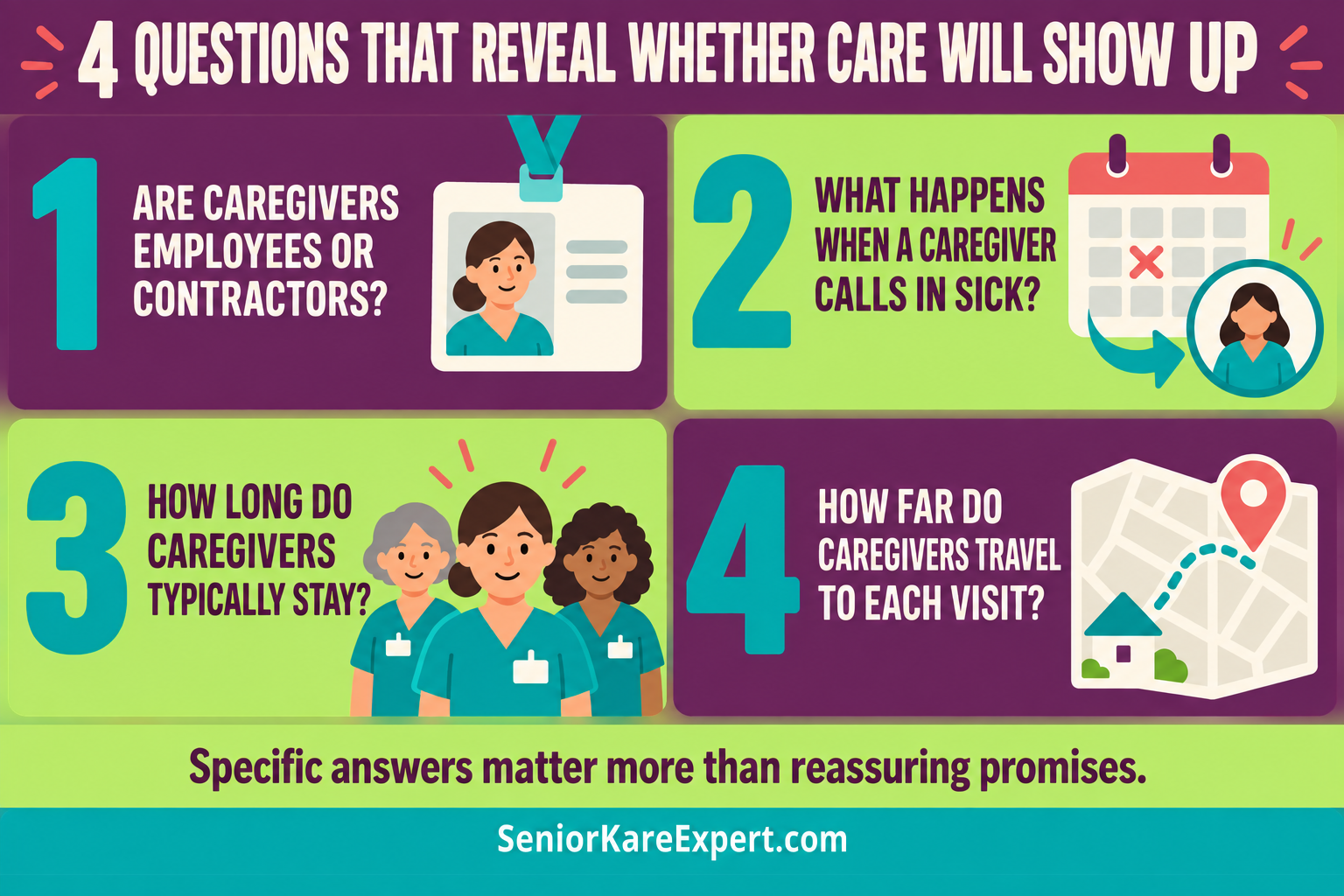
Ask whether caregivers are employees of the agency or independent contractors booked through an app. Employee-based agencies generally have more ability to send a backup caregiver on short notice; a contractor model often just leaves you with a cancellation and a phone number to call. Ask what actually happens when a scheduled caregiver calls in sick: is there a backup system, or does the visit simply get skipped? Ask how long caregivers typically stay with the agency, because turnover is the single biggest predictor of the kind of no-show pattern families describe: “the last agency did have a caregiver they sent,” one daughter wrote about her mother’s care, “but she would no show every other week.” And ask how far the agency’s caregivers actually travel to reach your parent. An agency with a thin roster spread across a huge service area is more likely to leave a shift unfilled than one that staffs a specific community closely.
If understanding the difference between what home care actually covers versus home health care is part of what’s confusing you here, I’ve also broken that down in Home Health Agency or Home Care Agency? Here’s the Difference That Actually Matters, since knowing which one you need changes which questions matter most. And if cost is part of what’s making this decision harder, how families in Texas actually pay for senior care is worth a read before you assume you can’t afford the more reliable option.
What This Looks Like Done Right
The flip side of all this is worth saying plainly: when the staffing and the continuity are actually there, it changes the entire experience of being a caregiver from a distance or from down the street. Families who’ve had it work well describe exactly that kind of relief: knowing the same person shows up, being able to rest easier because your parent is in hands you trust, even from three thousand miles away.
That consistency is what we’ve built our team at A Place At Home – North Austin around, for families across North Austin, Round Rock, Georgetown, and the surrounding communities. Every one of our caregivers is a W-2 employee, not an independent contractor booked through an app, which is exactly the distinction we told you to ask about above. It’s also a big part of why we can send a backup caregiver when something comes up instead of leaving a visit unfilled. Our North Austin location has been recognized as Best Employer of Choice specifically for how we invest in our caregivers, in a variety of ways, because caregivers who are taken care of are the ones who stay, and the ones who stay are the ones who show up. Reliable care isn’t something you can verify from a website. It’s something you can ask about, and we’d rather you ask hard questions now than find out the answers during an emergency.
The Next Step
If you’re evaluating a home care agency right now, please make sure to talk to several in your area and ask them all the tough questions and try to hire a local based agency. If you are in the North Austin area, we’ll walk you through exactly how staffing, backup coverage, and continuity work at A Place At Home – North Austin, and we’ll tell you honestly what to ask any agency you’re considering, including us.
Frequently Asked Questions
What can really happen if a caregiver misses a scheduled visit?
A missed caregiver visit can have consequences that go far beyond inconvenience. For an older adult who depends on help with medication reminders, meals, mobility, toileting, bathing, or supervision, even a single no-show can create immediate safety and health risks. A parent may miss important medications, become dehydrated, skip meals, or try to move around the home without assistance and suffer a fall. For someone living with dementia or memory loss, a missed visit can also trigger confusion, anxiety, wandering, or unsafe decisions such as leaving the stove on or opening the door to strangers. There is also an emotional cost. Many seniors build their day around a caregiver’s arrival, especially if they live alone. When no one shows up, they may feel abandoned, frightened, or reluctant to ask for help in the future. Family members often experience guilt, panic, and disruption as they scramble to fill the gap, leave work, or rearrange responsibilities at the last minute. In some cases, one missed visit becomes part of a larger pattern of unreliable care, which can increase hospitalizations, accelerate decline, and place unsustainable stress on adult children. That is why families should view a missed visit not as a small scheduling issue, but as a warning sign that continuity, communication, and backup planning need immediate attention.Why are missed caregiver visits especially dangerous for seniors with dementia, mobility issues, or complex medical needs?
Seniors with higher care needs are more vulnerable because their daily safety often depends on timely, hands-on assistance. A parent with dementia may not understand why the caregiver has not arrived, may be unable to use the phone to ask for help, or may forget critical precautions like using a walker, locking doors, or avoiding certain appliances. Without supervision, confusion can quickly turn into a medical or safety emergency. Even a short gap in care can lead to wandering, agitation, incontinence issues, or missed medication doses that affect behavior and cognition. For seniors with mobility limitations, the risk is often physical and immediate. If your parent needs help transferring from bed to chair, getting to the bathroom, preparing food, or preventing falls, a missed visit may leave them stranded in one place or force them to attempt tasks alone. That can result in falls, injuries, skin breakdown, dehydration, and delayed access to urgent care. For older adults managing diabetes, heart disease, Parkinson’s, stroke recovery, or post-surgical needs, timing matters. Missed help with meals, monitoring, medication, and movement can create cascading problems that become far more expensive and dangerous than the cost of dependable care. In these situations, reliability is not just a convenience feature. It is a core part of the care plan.What are the hidden financial and emotional costs of a missed caregiver visit for families?
The true cost of a missed visit is often much higher than the hourly rate of care. Financially, families may face last-minute emergency expenses such as transportation, urgent meal delivery, medication rush fees, or private backup care at premium rates. If the missed visit contributes to a fall, medication error, or worsening medical condition, the costs can escalate quickly into emergency room visits, hospital stays, rehabilitation, or even a move into a higher level of care. Adult children may also lose income by leaving work unexpectedly, using paid time off, or reducing hours to personally cover care gaps. The emotional toll can be just as significant. Families may live in a constant state of uncertainty, wondering whether the next visit will be covered or whether their parent is safe when no one is there. That stress can strain marriages, sibling relationships, and work performance. It often creates resentment when one family member becomes the default backup person. For the older adult, repeated missed visits can undermine trust, increase loneliness, and create a sense of instability that affects overall well-being. Over time, these hidden costs add up. What initially looks like a staffing hiccup can become a serious drain on family time, mental health, and long-term financial planning.How can families protect a parent from the risks of a missed caregiver visit?
The best protection is a proactive system, not just hope that scheduling will go smoothly. Start by asking any home care agency or independent caregiver detailed questions about attendance policies, shift confirmations, call-out procedures, and backup coverage. You want to know exactly what happens if a caregiver is sick, delayed, or unable to come. Reputable providers should have a clear escalation process, on-call support, and a realistic plan to notify the family quickly. It is also wise to establish a written care schedule, define which tasks are essential at each visit, and identify which missed tasks would create immediate health or safety concerns. From there, build layers of protection. Create an emergency contact chain that includes family, neighbors, and trusted friends who can respond if needed. Use technology where appropriate, such as caregiver check-in apps, door alerts, medication reminders, medical alert systems, or in-home cameras in common areas if everyone is informed and comfortable. Keep an updated list of medications, diagnoses, physician contacts, and daily routines in an accessible place. Most importantly, have a backup plan for every critical time of day, especially mornings, mealtimes, medication windows, and bedtime. Families cannot eliminate every disruption, but they can dramatically reduce the impact by making sure missed care does not automatically become a crisis.What should you do immediately if a caregiver does not show up for your parent?
First, confirm your parent’s safety as quickly as possible. Call them directly if they can reliably answer the phone. If they do not answer, contact a nearby neighbor, family member, building staff member, or anyone who can physically check on them right away. At the same time, contact the caregiver and the agency or scheduler to find out whether the caregiver is delayed, reassigned, or absent. Be specific and firm: ask when the caregiver was expected, whether anyone attempted to notify the family, and what backup coverage is being dispatched. If your parent depends on immediate assistance for mobility, medications, oxygen, diabetes management, toileting, or cognitive supervision, treat the situation as urgent. Once the immediate issue is resolved, document everything. Record the date, time, length of the missed visit, who you spoke with, what explanation was given, and whether your parent missed medications, meals, or essential care. This documentation is important if the problem happens again, if you need a billing adjustment, or if you decide to change providers. Then review whether this was an isolated breakdown or evidence of a reliability problem. One no-show without prompt communication is a concern. A pattern of lateness, weak follow-up, or lack of backup is a serious red flag. Your parent’s care arrangement should provide not only assistance, but confidence that someone dependable will be there when promised.
Stacey Eisenberg’s connection to senior care didn’t start with a job posting. It started at age three, in the activity room of a Coney Island nursing home where her mother worked. Growing up inside nursing homes in the 1970s and ’80s, she witnessed what genuine caregiving looked like before the industry got complicated by paperwork, liability, and the relentless pressure to do more with less. That became the standard she has spent her career trying to restore — bringing the Care back to caregiving.
By 13, Stacey had her first official job in senior care. Over the past four decades, she has worked across virtually every setting: nursing homes, assisted living communities, memory care residences, rehab centers, hospitals, and independent living. She served as Director of Fun for nearly 300 independently living seniors, coordinating daily events, activities, and outings.
Today, Stacey and her husband Bryan own A Place At Home – North Austin, an award-winning home care agency serving families across Round Rock, Georgetown, Cedar Park, Leander, Hutto, and surrounding Central Texas communities. Their agency has been voted Best Home Care Agency in Round Rock two years running (2024 and 2025) and received national recognition from Activated Insights as both a Best of Home Care Provider of Choice and Employer of Choice in 2025.
Stacey is a trained recreation therapist and serves as a Community Educator for the Alzheimer’s Association: Capital of Texas chapter. She serves as Treasurer on the Adult Protective Services Advisory Board and as Community Awareness Chair for the Aging Services Council. She co-facilitates the Williamson County Health Resource networking group and is a member of the National Aging in Place Coalition. In 2025, she was recognized as a finalist in the Woman of Wilco awards and is the creator of Peter’s Memory Beads, a passion project to raise funds for the Alzheimer’s Association.
Her expertise has been featured in U.S. News and World Report, AARP, and Care.com.