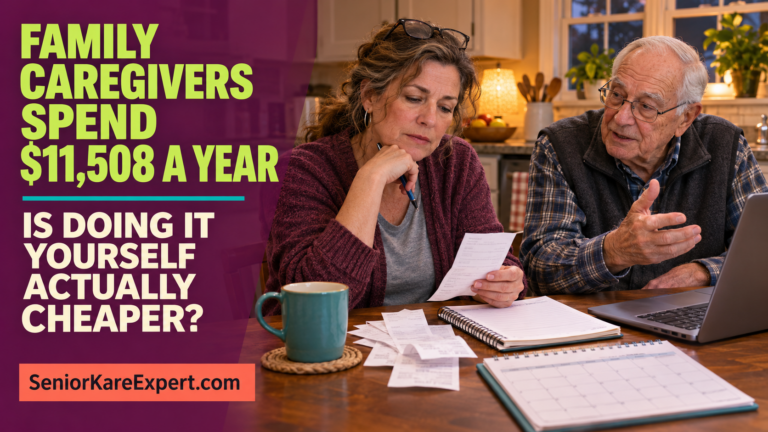
Run the numbers on caring for your dad yourself, and most people stop halfway through.
Gas for the extra trips. The afternoon you took off work for his cardiology appointment, then took off again two weeks later for the follow-up. The grab bars you bought and installed yourself on a Saturday. The copays, the supplies, the smart doorbell you added so you could check on him from your desk during a meeting. Nobody totals it up, because nobody bills you for it. AARP just ran the total anyway.
The Number
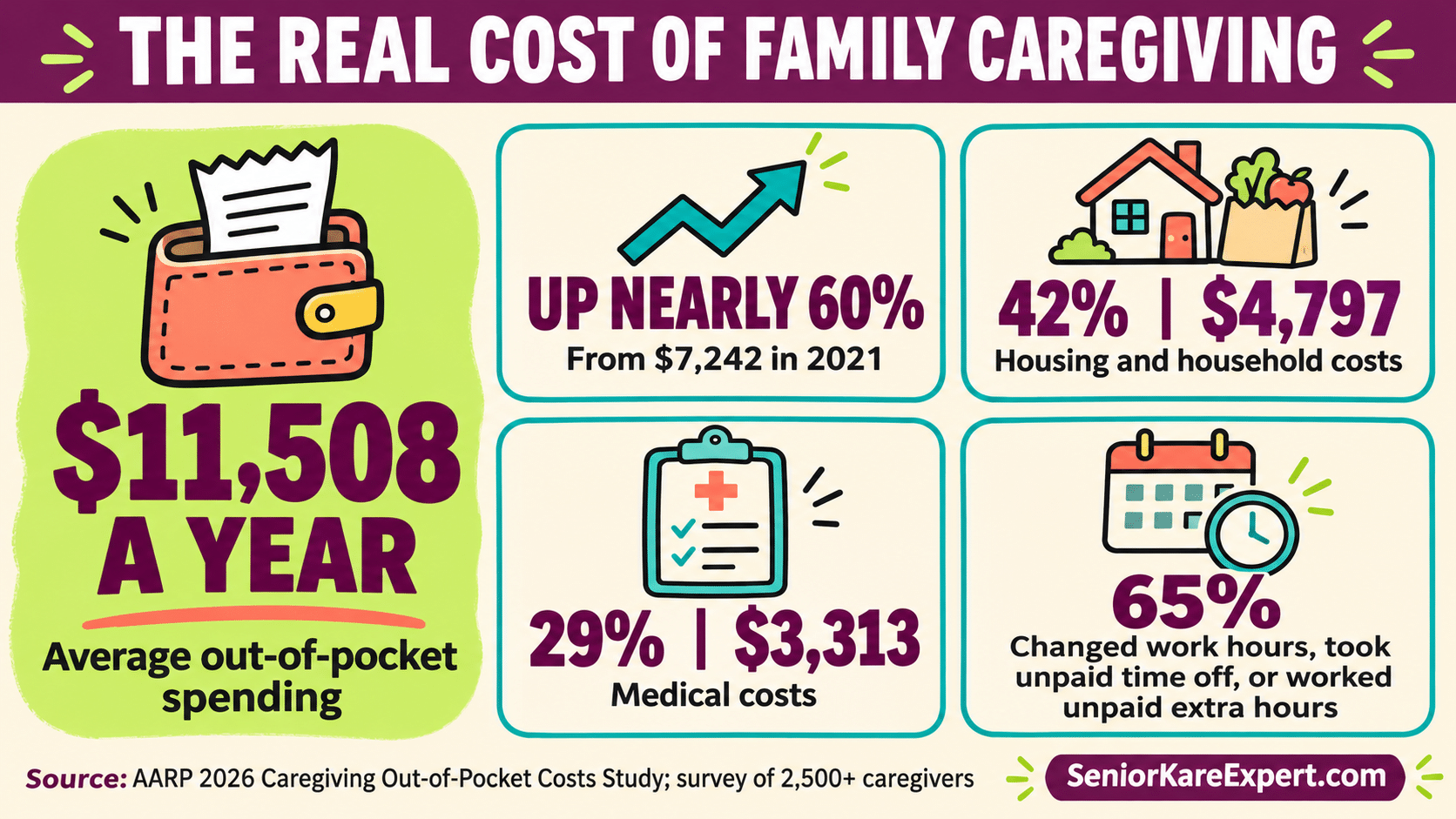
The average family caregiver now spends $11,508 a year of their own money, according to AARP’s new 2026 Caregiving Out-of-Pocket Costs Study, a survey of more than 2,500 caregivers. That’s up nearly 60% from $7,242 in 2021. AARP’s announcement puts it at 31% of the average caregiving household’s income, and 76% for households under $40,000.
Here’s the breakdown:
- Housing and household costs: 42% of spending, $4,797 a year. Modifications, supplies, groceries, gas.
- Medical costs: 29%, $3,313 a year. More than a third of that is insurance premiums, copays, and coinsurance.
- 65% of working caregivers changed hours, took unpaid time off, or worked extra hours they weren’t paid for.
- Caregivers who left the workforce early for this: $18,940 a year, 64% above the caregiver average.
- If your parent has dementia: $15,846 a year, versus $10,221 without.
- Don’t forget any caregiver products that make life easier.
None of that is what hiring help would cost. That’s what not hiring it already costs.
You’re Not Imagining the Imbalance
If you’ve got a sibling two states away who calls it “being there in spirit,” you already know how unevenly this gets split. It’s common enough that caregivers describe it almost the same way, over and over: the other ones didn’t bother to help, but they sure enjoyed their vacations.
Your family isn’t unusual there. One person ends up absorbing a cost that was never divided fairly to begin with, and everyone involved can usually guess who.
Why “Free vs. Paid” Is the Wrong Comparison
Compare the hourly rate of a caregiver against doing it yourself for free, and hiring loses every time. But that comparison was never honest. The real price just doesn’t show up on an invoice.
Caregivers who’ve actually run this math tend to land on the same conclusion: you can’t do it all. Something gives. A job. A marriage. Your own health. Sometimes your parent’s safety, when you’re stretched too thin to catch what’s changing.
That doesn’t mean hiring help makes the work disappear. It doesn’t. Families still handle real coordination even after a caregiver is in place, and we’ve written honestly about why hiring a caregiver didn’t make the job go away. But there’s a real difference between carrying all of it alone indefinitely and splitting it with someone whose job it actually is.
A Five-Minute Way to Actually Run Your Own Number
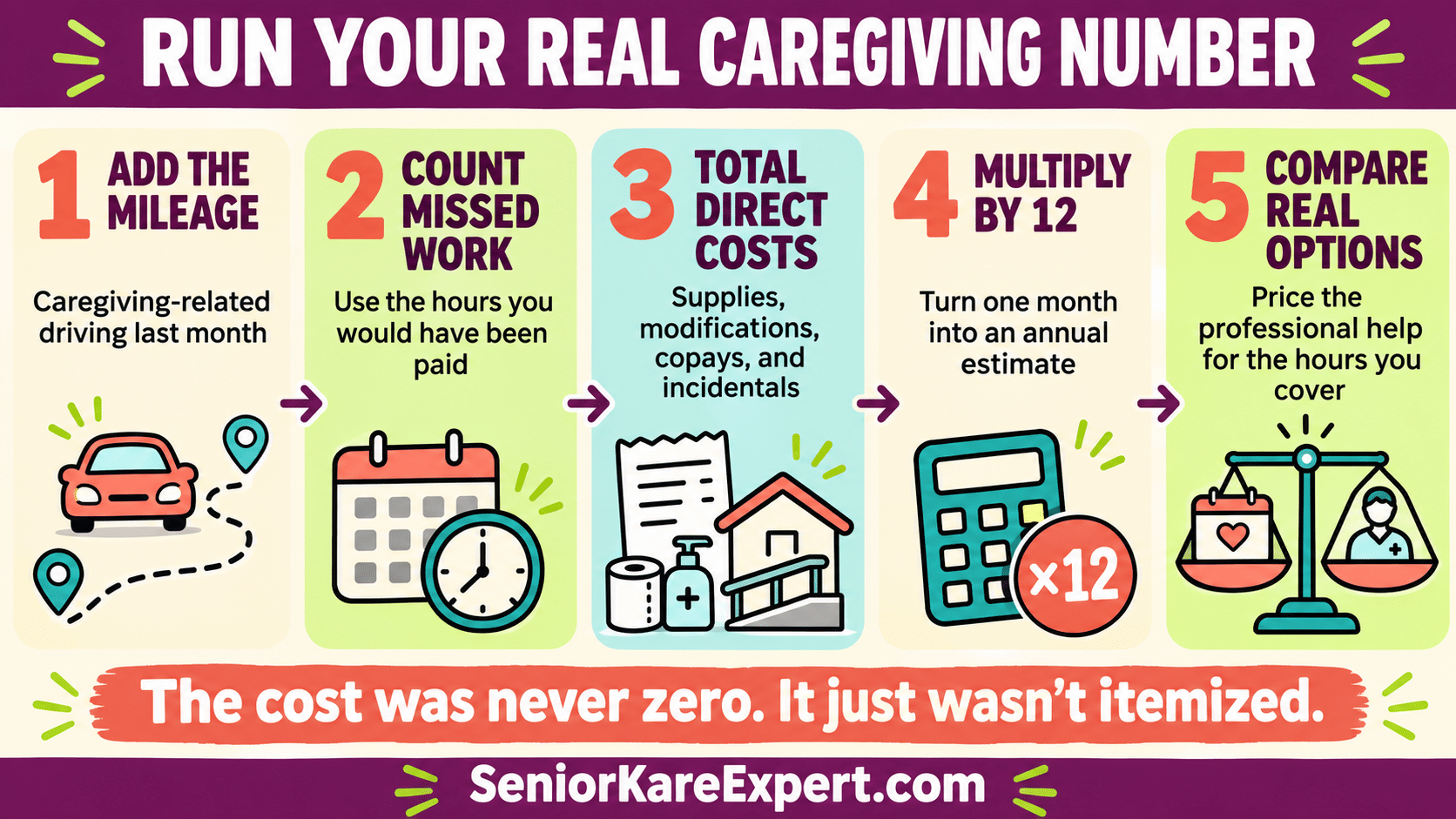
Most families have never done this math on purpose. It takes five minutes:
- Add up your mileage for caregiving-related driving over the last month.
- Add your actual missed-work hours, not vacation days, hours you’d otherwise have been paid or working toward something.
- Add what you’ve spent directly: supplies, modifications, copays, incidentals.
- Multiply the monthly total by 12.
- Compare that number to what professional in-home care would actually cost for the hours you’re covering yourself.
Run it honestly, and most families realize the real cost was never zero. It just wasn’t itemized until today.
What This Looks Like in North Austin, Round Rock, and Georgetown
Texas doesn’t have a state income tax, but it also doesn’t hand families a simple answer on how to pay for care. Most of the families we work with piece together more than one source: some private pay, VA Aid and Attendance for a veteran parent, or long-term care insurance that’s been sitting unused in a filing cabinet for a decade. If you haven’t sorted out which of those apply to your family, we broke it down in how families in Texas actually pay for senior care.
Running the real comparison, not the national average, is exactly what we sit down and do with families across North Austin, Round Rock, Georgetown and surrounding areas. We’re VA-credentialed and we work with the Medicaid waiver, so the funding side gets covered in that same conversation.
The Regret Isn’t the Money
Ask people who waited longer than they should have, and the regret is almost never about what they ended up spending on help. It’s about how long they held out first. The relief they describe almost always comes down to the same thing: they weren’t carrying it alone anymore.
Frequently Asked Questions
How much do family caregivers really spend out of pocket each year?
Recent estimates put the average annual out-of-pocket cost for family caregivers at $11,508, but that number often understates what many households actually experience. These expenses can include transportation to appointments, prescription copays, medical supplies, home modifications, special dietary needs, incontinence products, paid respite care, and higher utility bills from someone being home more often. For caregivers supporting a loved one with dementia, mobility limitations, or multiple chronic conditions, costs can rise significantly beyond the average.
What makes caregiving expenses especially difficult is that they are rarely limited to one clear monthly bill. Instead, they tend to accumulate in smaller, recurring amounts that can be easy to underestimate at first. A caregiver may spend money on gas one week, a walker the next, and then lose income from reduced work hours the following month. When added together over a year, the financial burden can be substantial. That is why families should look not only at direct medical costs, but also at the less visible day-to-day spending that comes with providing ongoing care at home.
Is taking care of a loved one yourself actually cheaper than hiring professional help?
It can be cheaper in some situations, but not always. Doing everything yourself may reduce the need to pay for home care aides, adult day services, or assisted living, yet the true cost of family caregiving includes both cash expenses and the value of your time. If a caregiver cuts back work hours, turns down promotions, uses unpaid leave, or leaves a job altogether, those lost wages can outweigh the savings from avoiding professional care. Over time, there may also be long-term financial consequences such as reduced retirement contributions, lower Social Security earnings, and fewer career opportunities.
There is also the question of sustainability. A caregiving arrangement that looks affordable on paper can become expensive if the caregiver becomes burned out, develops health problems, or reaches a point where emergency paid help is needed. In many households, the most cost-effective solution is not an all-or-nothing approach. A blended plan often works better, where family members handle some tasks while outside professionals cover specialized care, respite, or high-demand hours. Comparing options side by side with a realistic budget usually gives a much clearer answer than assuming unpaid family care is automatically the least expensive choice.
What hidden costs should families consider when comparing DIY caregiving with paid care?
Hidden costs are often what change the math. One major factor is lost income. If a family caregiver scales back employment, uses vacation time for appointments, or quits working entirely, that decision has an immediate and long-term financial impact. Families should also consider retirement savings, health insurance changes, and the value of benefits tied to employment. Even when caregiving does not fully interrupt work, reduced productivity and schedule disruption can still carry a real economic cost.
Beyond employment, there are many practical expenses that are easy to miss during early planning. These may include safety upgrades like grab bars or ramps, increased grocery costs, cleaning supplies, wearable medical devices, medication management tools, legal paperwork, and backup care when the primary caregiver is unavailable. Emotional and physical strain can create costs too, including the caregiver’s own doctor visits, therapy, or treatment for stress-related conditions. When families compare do-it-yourself care with professional support, the most accurate analysis includes not just what they are paying today, but what the arrangement may cost over months or years.
When does hiring professional caregiving support make more financial sense?
Professional support can make more financial sense when the level of care needed becomes medically complex, time-intensive, or unpredictable. If a loved one needs help with transfers, bathing, medication management, supervision for dementia-related behaviors, or frequent transportation to appointments, the amount of labor involved may exceed what one family member can reasonably provide without major personal or financial sacrifice. In those cases, paying for part-time or targeted professional help can protect the caregiver’s ability to keep working and prevent more expensive crises later.
It may also be financially smarter to hire help if doing everything yourself leads to repeated work absences, caregiver injury, or avoidable hospital visits for the person receiving care. Skilled care can improve consistency, reduce medication errors, and provide safer assistance with mobility or chronic condition management. For many families, the question is not simply whether they can avoid paying for outside help today, but whether strategic spending now can reduce larger losses later. A few hours of reliable weekly support can sometimes preserve both household income and caregiver well-being better than trying to manage every task alone.
How can families reduce caregiving costs without sacrificing quality of care?
Families can reduce costs by starting with a full care needs assessment and separating essential tasks from responsibilities that can be shared, simplified, or outsourced selectively. Not every caregiving duty requires the same level of skill. Relatives may be able to rotate errands, meal prep, check-ins, and transportation, while paid professionals handle personal care or medical-related tasks. Using a structured schedule can prevent one person from taking on too much and reduce the likelihood of paying for last-minute emergency coverage.
It is also important to explore outside resources. Depending on eligibility, support may be available through Medicaid programs, veterans benefits, state respite services, local nonprofits, aging agencies, adult day programs, disease-specific organizations, and employer caregiving benefits. Families should also review insurance coverage, flexible spending options, and tax rules that may help offset some expenses. Small adjustments can add up, such as ordering supplies in bulk, using generic medications when appropriate, consolidating medical appointments, and making low-cost home safety improvements early. The most effective approach is usually proactive planning: tracking actual caregiving expenses, revisiting the care plan regularly, and building a support system before the situation becomes overwhelming or unnecessarily costly.

Stacey Eisenberg’s connection to senior care didn’t start with a job posting. It started at age three, in the activity room of a Coney Island nursing home where her mother worked. Growing up inside nursing homes in the 1970s and ’80s, she witnessed what genuine caregiving looked like before the industry got complicated by paperwork, liability, and the relentless pressure to do more with less. That became the standard she has spent her career trying to restore — bringing the Care back to caregiving.
By 13, Stacey had her first official job in senior care. Over the past four decades, she has worked across virtually every setting: nursing homes, assisted living communities, memory care residences, rehab centers, hospitals, and independent living. She served as Director of Fun for nearly 300 independently living seniors, coordinating daily events, activities, and outings.
Today, Stacey and her husband Bryan own A Place At Home – North Austin, an award-winning home care agency serving families across Round Rock, Georgetown, Cedar Park, Leander, Hutto, and surrounding Central Texas communities. Their agency has been voted Best Home Care Agency in Round Rock two years running (2024 and 2025) and received national recognition from Activated Insights as both a Best of Home Care Provider of Choice and Employer of Choice in 2025.
Stacey is a trained recreation therapist and serves as a Community Educator for the Alzheimer’s Association: Capital of Texas chapter. She serves as Treasurer on the Adult Protective Services Advisory Board and as Community Awareness Chair for the Aging Services Council. She co-facilitates the Williamson County Health Resource networking group and is a member of the National Aging in Place Coalition. In 2025, she was recognized as a finalist in the Woman of Wilco awards and is the creator of Peter’s Memory Beads, a passion project to raise funds for the Alzheimer’s Association.
Her expertise has been featured in U.S. News and World Report, AARP, and Care.com.