

“I swear they’re just doing this to drive me crazy.”
If I had a dollar for every time an adult child said that to me, I’d be writing this from a beach somewhere instead of my desk.
The conversation usually starts the same way. My mom refuses to shower. My dad won’t let the caregiver help him. She won’t change her clothes. He insists he already brushed his teeth. And then comes the sentence almost everyone eventually says out loud:
“They’re so stubborn.“
Let’s be fair for a second. Some people have always been stubborn. If your dad argued with the GPS, the weather forecast, and the cashier who told him his coupon expired, he probably didn’t mellow out at eighty-five.
But here’s what years of working alongside families has taught me: most of the behavior that looks like stubbornness in someone living with dementia has very little to do with personality. It has everything to do with how the brain works. Or, more precisely, how it no longer works the way it used to.
What Executive Function Actually Does (And Why It Matters Here)
One of the biggest changes in Alzheimer’s disease and many related forms of dementia involves something called executive function. It sounds technical, but the concept is simple. Executive function is your brain’s ability to plan, organize, start a task, make decisions, switch between activities, and complete all the small steps most of us never consciously think about.
Your brain runs through this process thousands of times a day without asking for credit. Until the day it can’t.
That’s when families start noticing behavior that doesn’t add up.
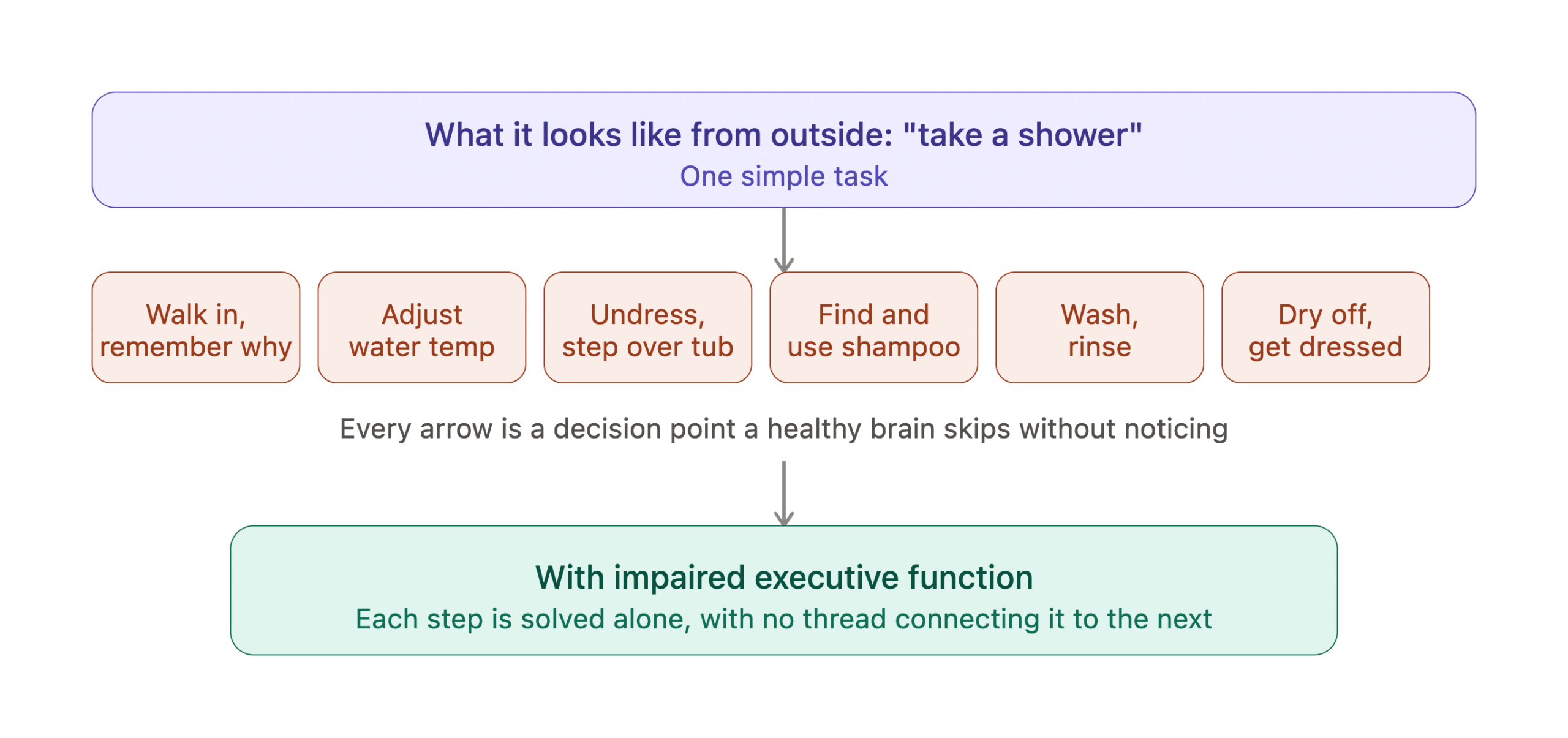
Take something as ordinary as a shower. Most of us think of it as one task. It isn’t. It’s a sequence of a dozen smaller tasks strung together: walk into the bathroom, remember why you’re there, adjust the water, undress, step over the tub edge, identify which bottle is shampoo, remember what comes next, wash, rinse, dry off, find clean clothes, and get dressed again.
When executive function is impaired, that “simple shower” becomes a complicated puzzle solved while standing on one foot. Would you sign up for that every single day?
Most of us wouldn’t either.
Why Getting Dressed Can Turn Into “World War Three”
I remember a daughter who called me completely worn down. “Every morning is a battle,” she said. “Mom just refuses to get dressed.”
I asked her to walk me through what actually happened. She opened the closet. Asked her mom what she wanted to wear. Held up four outfits. Suggested a sweater because it was chilly. Asked if she wanted blue pants or black pants. Asked whether socks or shoes came first.
By the time she finished, I felt overwhelmed, and my brain works just fine.
For someone with impaired executive function, every one of those questions is a separate problem to solve, layered on top of the last one. Sometimes what looks like opposition is actually overload.
Teepa Snow, an occupational therapist and one of the leading educators in dementia care, often reminds caregivers that when we change our approach, we often change the response. Instead of asking someone to organize a task they can no longer hold together in their mind, we become their guide. We simplify. We cue. We demonstrate. We support instead of direct.
That small shift changes a lot. Instead of asking “What do you want to wear today?” lay out one outfit. Hand over the shirt. Smile. Wait. No quiz. No multiple choice. No pressure.
When “Refusing Care” Is Really About Safety
Families often tell me their parent suddenly hates the caregiver. Maybe. But maybe not.
Picture someone you’ve never met walking into your home and announcing they’re there to help you shower. You wouldn’t exactly throw a party. Now picture that your memory doesn’t let you retain meeting this person yesterday, or last week. Every visit feels like the first visit. Your brain registers a stranger in your house, and your nervous system reacts accordingly.
That’s not refusal. That’s a brain trying to stay safe in the only way it knows how. Healthy brains are wired to be cautious around unfamiliar situations too. A dementia-affected brain just can’t update the “this person is familiar” file the way it used to.
The Word Families Need to Know: Anosognosia
Another piece of this puzzle is anosognosia, a clinical term for something families see constantly. The person genuinely doesn’t recognize that their thinking or memory has changed. Not because they’re lying. Not because they’re in denial. Because the part of the brain responsible for recognizing those changes has also been affected by the disease.
If Dad insists he already showered, he likely believes it completely. Arguing won’t fix it. Facts won’t fix it. Winning the argument definitely won’t fix it.
I know how frustrating that is. I’ve watched exhausted spouses and adult children try logic, bargaining, pleading, and the kind of dramatic sigh that deserves an award. Most of the time, none of it works, not because anyone is failing, but because those strategies are built for a healthy brain. A brain affected by dementia plays by different rules.
What Changes When Families Understand This
Once families understand what’s actually happening, something shifts. They stop fighting the person and start working with the brain in front of them today.
That doesn’t mean every day gets easier. It means it gets a little more workable.
Instead of “You need a shower,” try “Let’s go freshen up.” Instead of explaining every step, offer one cue at a time. Instead of six questions, ask one. Instead of correcting, redirect. Instead of rushing, slow down. Twenty extra seconds of patience can save twenty minutes of conflict.
Teepa Snow’s reminder that we need to meet people where they are, not where we wish they were, sounds simple but takes real practice. We naturally want our parents to think the way they always have. We want yesterday’s brain to handle today’s problems. Dementia doesn’t work that way. The brain changes, so the approach has to change with it. Not because anyone gave up, but because something new was learned.
What Cueing Actually Looks Like at Shower Time
It helps to see this in practice, so let’s walk through it.
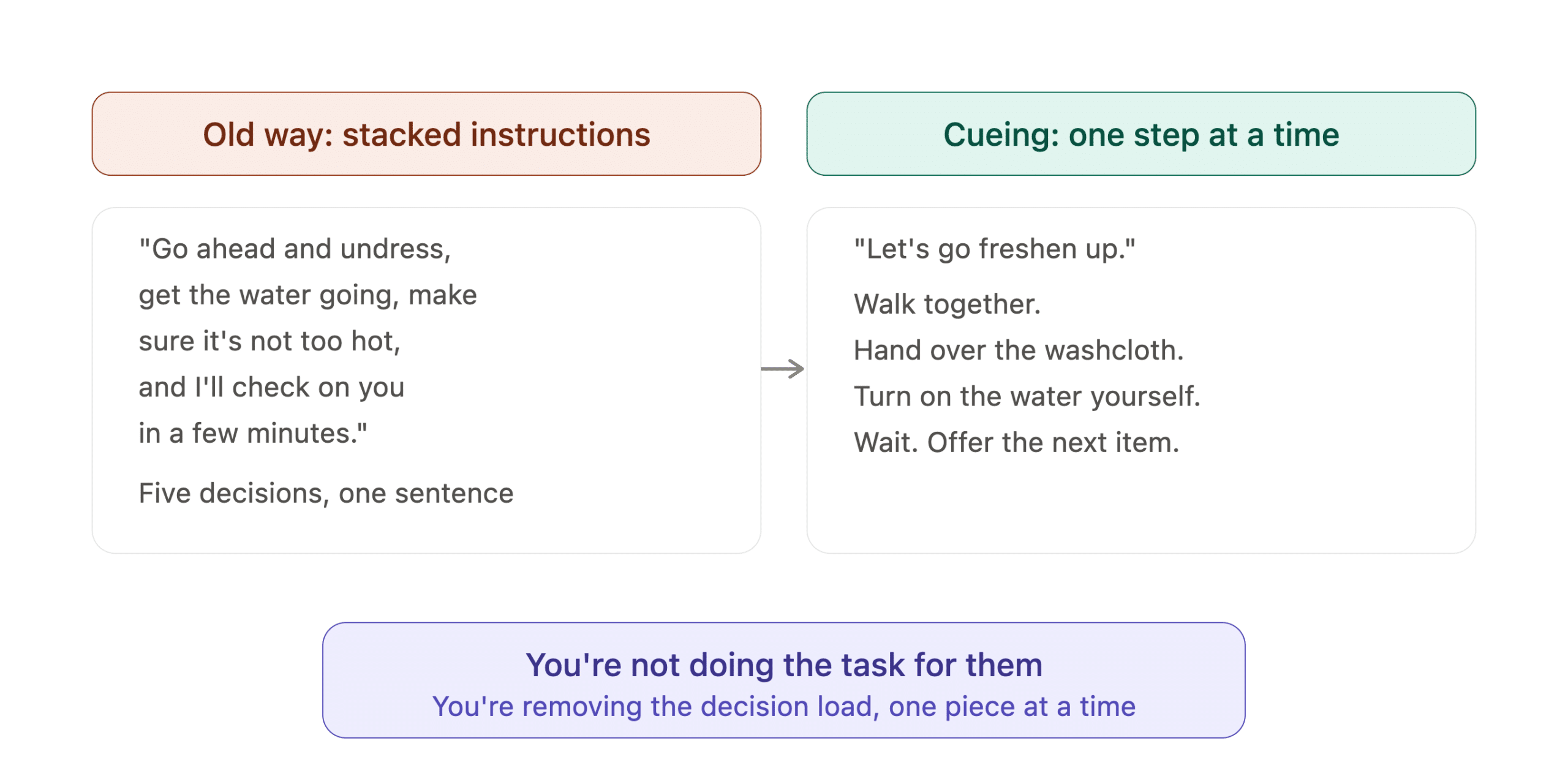
The old way usually sounds like this: “Okay, let’s get you showered. Go ahead and undress, get the water going, make sure it’s not too hot, and I’ll be back in a few minutes to check on you.” That’s five instructions stacked into one sentence. For a healthy brain, that’s a to-do list. For a brain with impaired executive function, it’s static.
Here’s what cueing looks like instead.
You walk in and say, “Let’s go freshen up.” Not a question. Not a debate. A simple invitation, said warmly.
You walk together to the bathroom. You don’t send them ahead.
You hand them a washcloth, not a list of steps. “Here you go.” Wait. Let them take it.
You turn on the water yourself and test the temperature, so that’s one less decision sitting on their plate.
You point, rather than explain. If they pause at the shampoo bottle, you pick it up and put it in their hand. You don’t say “remember, that’s the shampoo, you used it yesterday.” You just hand it over.
If they get stuck mid-step, you offer one cue, not a paragraph. “Like this,” paired with a simple gesture, often works better than any sentence you could say.
You narrate gently, not instructively. “There you go” lands very differently than “you missed a spot.”
Notice what’s missing from this version. No quiz. No multi-step instructions. No corrections. No rushing. Each piece of the task is handed over one at a time, the same way you’d help a friend carry too many grocery bags by simply taking a few off their hands instead of telling them how to rearrange their arms.
This is what Teepa Snow means by becoming the guide instead of the director. You’re not doing the shower for them, and you’re not demanding they do it your way either. You’re removing the decision-making load piece by piece, so the only thing left for their brain to do is the next physical step in front of them.
It won’t look the same every day. Some mornings this approach will go smoothly. Other mornings it won’t, and that’s not a sign you’re doing it wrong. It’s a sign the brain you’re working with changes day to day too.
Curiosity Beats Criticism
The families who hold up best over time aren’t the ones with fewer challenges. They’re the ones who get curious instead of critical.
When Mom refuses a shower, they ask: what’s making this hard right now? When Dad won’t let the caregiver in, they ask: what feels unsafe to him in this moment? When someone says no, they stop assuming the answer is stubbornness. Sometimes it is. A lot of the time, it isn’t.
Here’s the part that surprises people. When you stop taking the behavior personally, the relationship changes. Frustration softens. Expectations get more realistic. Compassion grows. And often, your parent grows calmer too. Not every day, not in every situation, but more often than most families expect.
According to the National Institute on Aging, more than six million Americans are currently living with Alzheimer’s disease, and that number is projected to grow significantly as the population ages. Behind nearly every one of those diagnoses is a family trying to figure out, in real time, why their parent suddenly seems so hard to reach.
The next time someone tells you your parent is just being stubborn, pause before you agree. The person you love may be working twice as hard to do something that once came easily. They don’t need a debate. They don’t need to be convinced. They need someone willing to see the world through the brain they actually have today.
That kind of understanding is one of the greatest gifts you can give them. And maybe, just maybe, it’s one of the greatest gifts you can give yourself too.
—
References
Snow, T. Positive Approach to Care. teepasnow.com
Alzheimer’s Association. Understanding Dementia and Changes in Thinking. alz.org
National Institute on Aging. What Happens to the Brain in Alzheimer’s Disease? nia.nih.gov
Diamond, A. (2013). Executive Functions. Annual Review of Psychology, 64, 135-168.
Frequently Asked Questions
Is my parent really being stubborn, or could something else be causing this behavior?
What looks like stubbornness is often something much more complicated. In many older adults, especially those living with dementia, cognitive decline, stroke history, Parkinson’s disease, depression, anxiety, or other neurological changes, the brain may no longer process information, routines, or physical sensations the way it once did. A parent who refuses to shower may not be trying to “win” a battle. They may feel confused, overwhelmed, cold, embarrassed, physically unsteady, or unable to understand why the shower is necessary at that moment. A parent who insists they already brushed their teeth may genuinely believe they did, because short-term memory and sequencing are impaired. This matters because labeling the behavior as simple stubbornness can lead families to respond with pressure, correction, or arguments, which usually make the situation worse. When the brain is changing, logic alone often does not work. The more helpful question becomes: what is making this task feel difficult, threatening, or impossible right now? Once you shift from “Why are they doing this to me?” to “What might their brain or body be experiencing?” your approach changes. That shift often reduces conflict and helps you respond with more skill and less resentment.Why does my parent fight help with basic things like bathing, dressing, or brushing their teeth?
Resistance to personal care is extremely common, and it usually has multiple causes at once. Personal care tasks require privacy, trust, physical comfort, memory, attention, sequencing, balance, and the ability to tolerate being guided by someone else. If any of those abilities are weakened, the task can feel threatening. Your parent may not understand who the caregiver is, may not recognize the need for the task, may feel exposed or ashamed, or may be frightened by rushing water, slippery floors, unfamiliar hands, or commands that come too quickly. There may also be physical causes families overlook. Arthritis can make undressing painful. Cold air can make a shower intolerable. Neuropathy can make standing unsafe. Hearing loss can make instructions sound harsh or confusing. Dementia can cause a person to misinterpret help as control or even danger. In some cases, they may experience a loss of initiation, meaning they are not actively refusing so much as they cannot organize themselves well enough to begin. That is why success often depends less on “convincing” and more on adjusting the environment and the approach. Warmer rooms, simpler steps, softer language, familiar routines, same-gender caregivers when preferred, and offering choices such as “Would you like to wash up before breakfast or after?” can help significantly. The goal is not to overpower resistance. It is to reduce the reasons the task feels unsafe or impossible in the first place.How should I respond in the moment when my parent refuses care or insists something untrue?
In the moment, the most effective response is usually calm, simple, and non-confrontational. If your parent says, “I already did that,” or “Leave me alone,” resist the urge to argue facts. Correcting them point by point may feel logical to you, but if memory, reasoning, or perception are impaired, correction can quickly escalate distress. Instead, validate the feeling underneath the statement and redirect. For example, “I know you don’t feel like doing that right now,” or “Okay, let’s make this easier,” is often more productive than “No, you didn’t brush your teeth.” It also helps to slow down. Use short sentences. Offer one step at a time. Reduce background noise. Approach from the front. Maintain a relaxed tone. If they become agitated, step back rather than pushing through. A brief pause can prevent a full power struggle. Sometimes the best answer is to try again in ten minutes, after a snack, after the bathroom, or at a different time of day when they are less tired or confused. You are not “giving in” by changing your approach. You are adapting to the realities of how their brain is working in that moment. Think less in terms of winning compliance and more in terms of preserving dignity, trust, and safety. That mindset leads to better outcomes for both of you.When should I worry that this behavior signals a bigger medical or cognitive problem?
You should pay closer attention when the behavior is new, worsening, or clearly out of character. A parent who suddenly becomes far more resistant, confused, suspicious, withdrawn, or agitated may not just be “having an attitude.” Sudden changes can be caused by urinary tract infections, dehydration, medication side effects, pain, constipation, poor sleep, hearing or vision changes, depression, delirium, or a neurological event. Even someone with known dementia can show a sharp decline when another medical issue is present. It is also important to watch for patterns. Are refusals happening only at certain times of day? Is there more resistance with one caregiver than another? Does the behavior appear around bathing, toileting, or clothing changes specifically? These details help identify triggers and can be useful when speaking with a doctor. If memory problems, impaired judgment, getting lost, unsafe decisions, paranoia, hallucinations, major personality changes, or inability to manage daily activities are becoming more common, a formal medical evaluation is appropriate. Families often wait too long because they assume difficult behavior is just aging or personality. It is not. Aging alone does not typically cause severe confusion, repeated inability to complete familiar tasks, or extreme resistance that disrupts daily care. If something feels off, trust that instinct and get it evaluated. Early recognition can lead to better treatment, better planning, and more realistic expectations.How can I stop taking this so personally and reduce the constant conflict at home?
This is one of the hardest parts of caregiving, because even when you intellectually understand that brain changes may be involved, it still feels personal when you are the one being argued with, rejected, accused, or exhausted. The first step is to remember that intent and impact are not the same. The impact on you is very real, but the intent may not be. Your parent may not be choosing defiance in the way it seems. They may be reacting from fear, confusion, sensory discomfort, impaired judgment, or a damaged ability to process what is happening around them. It also helps to stop measuring cooperation by the standards they used to meet. If your parent once handled everything independently, today’s resistance can feel infuriating because you keep comparing the present to the past. But caregiving usually becomes easier when expectations are adjusted to current ability, not former personality. Instead of asking, “Why are they acting like this?” try asking, “What can they still do, what is too hard now, and how can I make this simpler?” That mental shift reduces blame and creates more workable routines. Finally, protect your own bandwidth. Chronic conflict is draining. Get support from a dementia-informed clinician, caregiver coach, support group, or geriatric care professional if needed. Build breaks into the routine. Share responsibilities when possible. Learn a few reliable de-escalation strategies and use them consistently. You are not supposed to absorb endless stress without help. Understanding that your parent’s brain may be working against them does not erase the difficulty, but it can help you respond with more compassion, less anger, and far less unnecessary battle.
Stacey Eisenberg’s connection to senior care didn’t start with a job posting. It started at age three, in the activity room of a Coney Island nursing home where her mother worked. Growing up inside nursing homes in the 1970s and ’80s, she witnessed what genuine caregiving looked like before the industry got complicated by paperwork, liability, and the relentless pressure to do more with less. That became the standard she has spent her career trying to restore — bringing the Care back to caregiving.
By 13, Stacey had her first official job in senior care. Over the past four decades, she has worked across virtually every setting: nursing homes, assisted living communities, memory care residences, rehab centers, hospitals, and independent living. She served as Director of Fun for nearly 300 independently living seniors, coordinating daily events, activities, and outings.
Today, Stacey and her husband Bryan own A Place At Home – North Austin, an award-winning home care agency serving families across Round Rock, Georgetown, Cedar Park, Leander, Hutto, and surrounding Central Texas communities. Their agency has been voted Best Home Care Agency in Round Rock two years running (2024 and 2025) and received national recognition from Activated Insights as both a Best of Home Care Provider of Choice and Employer of Choice in 2025.
Stacey is a trained recreation therapist and serves as a Community Educator for the Alzheimer’s Association: Capital of Texas chapter. She serves as Treasurer on the Adult Protective Services Advisory Board and as Community Awareness Chair for the Aging Services Council. She co-facilitates the Williamson County Health Resource networking group and is a member of the National Aging in Place Coalition. In 2025, she was recognized as a finalist in the Woman of Wilco awards and is the creator of Peter’s Memory Beads, a passion project to raise funds for the Alzheimer’s Association.
Her expertise has been featured in U.S. News and World Report, AARP, and Care.com.