Growing up, I spent a lot of time in the nursing home where my family worked in Coney Island. It shaped how I see aging, care, and what it means to truly live well in your later years.
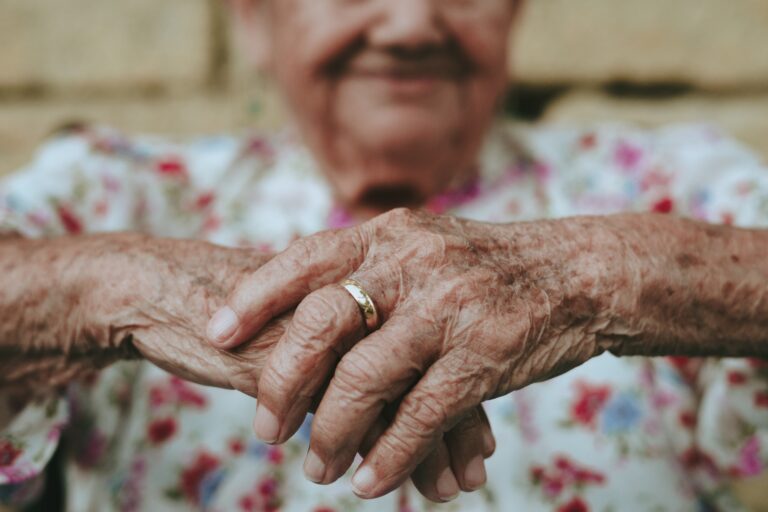
One resident I’ll never forget was Peter. He was 116 years old when he passed, the oldest resident we had ever seen. He was blind and used a wheelchair, but otherwise his health was remarkably intact. No major illness. No dramatic decline. Just the long, quiet accumulation of years.
What struck me most about Peter wasn’t his age. It was what happened when no one was with him.
He would sit and count the beads on his wrist. Over and over. That was his world when left alone with his thoughts.
But when someone sat with him and asked him to talk, Peter came alive. His stories spanned more than a century. He had lived through things most of us only read about. And while he was sharing those stories, something shifted in him. His posture changed. His voice changed. He was fully present, engaged, and purposeful.
Peter taught me something I’ve carried ever since: the brain needs more than safety and nutrition. It needs a reason to show up.
What the Research Tells Us
That instinct I had watching Peter is now backed by decades of serious science.
The 2024 report of the Lancet Commission on dementia prevention found that around 45% of dementia cases are potentially preventable by addressing 14 modifiable risk factors. That is not a small number. Nearly half of all cases may be influenced by things we can actually do something about, including how cognitively active we stay as we age.
The National Institute on Aging has found that participating in cognitively stimulating activities may be linked to better cognitive function in older adults and may also reduce risk among those at an otherwise increased risk for dementia.
The brain is not static. It continues adapting throughout life through a process called neuroplasticity, forming and reinforcing connections in response to how we use it. When we challenge the brain consistently, we strengthen it. When we stop, those connections weaken.
Research from Frontiers shows that age-related cognitive decline can be reduced through interventions including cognitive stimulation, social engagement, and mental wellbeing.
The Crossword Puzzle Study That Changed How We Think About This
One of the most compelling studies I come back to again and again is the Bronx Aging Study, a 20-year longitudinal study that tracked hundreds of older adults over time.
Among participants who ultimately developed dementia, those who regularly did crossword puzzles experienced a 2.54-year delay in the onset of accelerated memory decline compared to those who did not.
Two and a half years. That is not a rounding error. That is two and a half more years of recognizing faces, remembering names, holding conversations, and staying present with the people you love.
A Alzdiscovery separate study of 19,078 cognitively healthy adults between the ages of 50 and 93 found that those who did word or number puzzles at least once a month showed significantly better performance across all cognitive domains compared to those who never used them.
The Science Behind Why It Works
What is actually happening in the brain when we stay mentally active?
Researchers point to something called cognitive reserve. Think of it as the brain’s cushion. It does not stop the biological changes of aging, but it helps the brain compensate for those changes and function better for longer.
A 2024 systematic review and meta-analysis found that cognitively stimulating activities in late life may help preserve the integrity of the brain’s white matter, contributing to reduced dementia risk. The review also found that cognitive reserve built in both early and late life may offer slightly higher protective effects against dementia compared to middle life.
A 2024 meta-analysis of randomized controlled trials on Cognitive Stimulation Therapy found significant beneficial impacts on global cognition, language, working memory, depression, neuropsychiatric symptoms, communication, self-reported quality of life, and severity of dementia according to ScienceDirect.
And the benefits are not limited to any one type of activity. A 2025 systematic review found that both group and individual cognitive stimulation were effective in supporting cognitive functions in people living with dementia at any degree of severity.
Social Engagement Is Its Own Kind of Brain Exercise
Back to Peter.
When he was counting those beads alone, his brain was running on a loop. When he was telling his stories, he was doing something far more complex: organizing memory, sequencing events, reading social cues, adapting his narrative to his audience, and feeling the emotional reward of being heard.
That combination is powerful.
Research on nursing home residents found that lower social engagement was associated with significantly higher odds of cognitive impairment, and that social engagement may be protective against the risk of cognitive decline.
A 10-year follow-up study of nursing home residents in PubMed found that those with high social engagement had an 18% lower five-year mortality risk and a three-year increase in median survival compared to residents with similar health profiles but low or no social engagement.
Three more years. Just from staying engaged with other people.
Social interaction is not a luxury or a nice-to-have in elder care. It is medicine and why I spent most of my career as a recreational therapist encouraging social interaction amongst seniors.
What Actually Helps: Activities That Work
The good news is that brain-protective activities do not need to be complicated. The best ones are the ones a person will actually do consistently, which means they need to be enjoyable, accessible, and at least mildly challenging.
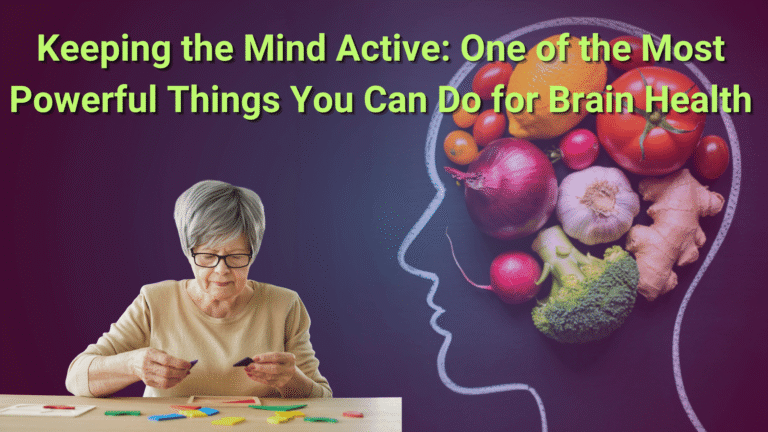
Puzzles and games. Crosswords, Sudoku, board games, and card games engage memory, language, and problem-solving all at once. The research on puzzles specifically is some of the most consistent in this field. Even counting beads like Peter helps.
Reading. Even a modest daily reading habit makes a measurable difference. The key is reading something that requires focus and comprehension, not just skimming.
Learning something new. A new hobby, a new recipe, a new card game, a new language. Novelty forces the brain to build new pathways rather than rely on existing ones, which is where the real work happens.
Storytelling and conversation. This one is underrated. Sharing memories, recounting life experiences, and engaging in real dialogue activate multiple cognitive systems simultaneously. Peter was doing this every time someone sat with him.
Creative activities. Music, art, writing, and crafts all combine fine motor skills, memory, and self-expression in ways that support both brain health and emotional wellbeing.
A 2024 study published in the Journal of Alzheimer’s Disease found that after six weeks of group-based cognitive training, 70% of participants who had been diagnosed with mild cognitive impairment were no longer diagnosed as such after completing the program.
The Bigger Picture: No Single Habit Does It Alone
Mental stimulation is one of the most accessible tools we have, but it works best as part of a larger picture.
The 2024 Lancet Commission identified 14 modifiable risk factors for dementia and found that addressing them across the life course is the most effective approach, with mid-life interventions having the greatest overall impact and late-life interventions playing a meaningful role as well.
Physical activity, quality sleep, social connection, hearing health, and proper nutrition all belong in that picture. But cognitive engagement is unique in one respect: it is something most people can do right now, today, at home, with tools they already have.
A Final Thought
Peter lived 116 years. He outlasted nearly everyone he had ever known. By the time I met him, most of his world was gone, and his vision along with it.
But his mind was still there. And when someone showed up and gave it something to do, it showed up too.
I think about him whenever a family asks me what they can do. The answer is not always complicated. Sometimes it is sitting down with your loved one and asking them to tell you a story you have never heard. Bringing a puzzle to the next visit. Playing a card game that requires some real thinking.
These things are not cures. The science is very clear about that. But they are protective, they are meaningful, and they are within reach for almost every family we serve.
The brain wants to stay active. Give it the chance.
Frequently Asked Questions
Why is keeping the mind active so important for brain health as we age?
Keeping the mind active matters because the brain responds to use. Just like muscles weaken without movement, the brain can become less efficient when it is not regularly challenged. Mental activity helps support memory, attention, problem-solving, language, and emotional resilience. It may also help strengthen what researchers often call “cognitive reserve,” which is the brain’s ability to adapt and compensate for age-related changes over time. That does not mean puzzles or reading can guarantee the prevention of dementia, but it does mean that staying mentally engaged is one of the most practical and meaningful ways to support long-term brain function.
For many families, this becomes especially clear when they spend time around older adults with very different aging experiences. Some people remain mentally sharp, curious, and socially connected well into advanced age, even when their bodies slow down. Others begin to withdraw, lose routine, or stop engaging with the world around them, and their decline can seem to accelerate. That contrast is powerful. In later life, mental activity is not only about preserving cognition in a clinical sense. It is also about preserving identity, dignity, and a reason to stay involved in daily life. A person who continues learning, remembering, asking questions, and participating in conversations often maintains a stronger sense of self.
What makes this so important is that mental stimulation is accessible in many forms. It does not require academic achievement or expensive programs. It can come from storytelling, conversation, music, games, prayer, writing, reading, reminiscing, learning a new skill, or simply staying interested in other people. The goal is not perfection or performance. The goal is engagement. A brain that is invited to participate regularly has more opportunities to stay active, responsive, and connected.
What kinds of activities actually help keep the brain active?
The most beneficial activities are usually the ones that combine interest, challenge, and consistency. Reading, writing, doing crosswords, playing cards, learning a language, trying a new hobby, listening to music, discussing current events, and practicing memory exercises can all be helpful. What matters most is that the activity asks the brain to pay attention, make connections, recall information, or solve problems. Repetition alone is not always enough. The brain benefits when it has to adapt, interpret, and stay alert.
That said, brain health is not limited to traditional “brain games.” Social interaction is one of the strongest forms of mental stimulation available. Conversation requires memory, emotional processing, listening, language, and quick thinking all at once. For older adults, especially those who may have physical limitations, regular social engagement can be just as important as reading or puzzles. Talking with family, telling stories from the past, participating in group activities, or even having a meaningful daily check-in can help keep the mind engaged in a natural and emotionally rewarding way.
It is also helpful to choose activities that feel purposeful. Organizing photographs, teaching a grandchild a recipe, discussing books, singing familiar songs, journaling, or learning to use a new device can be deeply stimulating because they connect mental effort with meaning. For someone with vision loss, limited mobility, or frailty, activities can be adapted. Audiobooks, tactile games, conversation-based memory prompts, and music can all become powerful tools. The best activity is often the one a person will genuinely want to return to, because consistency is what turns stimulation into a lasting habit.
Can mental activity still make a difference for someone in very old age?
Yes, absolutely. One of the biggest misconceptions about aging is that there comes a point when mental stimulation no longer matters. In reality, meaningful engagement can be valuable at almost any age. Even in very late life, the brain continues to respond to experience, emotion, novelty, and connection. A person does not have to be studying a textbook or mastering a difficult skill for the mind to benefit. Listening, reflecting, remembering, conversing, and participating in simple daily choices all support mental involvement.
This is especially important when thinking about people who have physical impairments. Someone may be blind, use a wheelchair, or have limited energy, and still remain mentally present and deeply engaged. Physical limitation does not automatically mean cognitive decline. In fact, many older adults maintain strong thinking abilities when they continue to be included, spoken with respectfully, and invited into real conversation. Too often, society underestimates very old people and stops challenging them in healthy ways. When that happens, the environment itself can become mentally shrinking.
Mental activity in advanced age is also about quality of life. A person who is encouraged to remember, laugh, express opinions, tell stories, and stay curious often experiences more than just cognitive benefit. They experience belonging. They remain part of the human exchange. For families and caregivers, this is an important lesson: do not assume it is too late. It is rarely too late to stimulate the mind, support attention, and create moments of connection that make a person feel awake to life.
How can families and caregivers help older adults stay mentally engaged?
Families and caregivers play a major role because mental stimulation often depends on environment as much as individual effort. One of the best things they can do is treat the older adult as someone with thoughts, preferences, and experiences worth engaging. That means asking real questions, inviting opinions, discussing memories, sharing news, and making room for conversation rather than speaking only about care tasks. Respectful interaction itself is mentally activating. It encourages attention, recall, language, and emotional connection.
Routine also helps. A predictable rhythm that includes conversation, music, reading, games, walks, spiritual practice, or social time can give the brain regular opportunities for engagement. Caregivers can rotate activities to prevent boredom while still keeping them familiar enough to feel comfortable. Small moments count. Looking through old photographs, listening to favorite songs, asking about childhood memories, or discussing what is happening outside the window may seem simple, but these moments can spark memory and alertness in meaningful ways.
It is equally important to adapt activities to the person’s abilities rather than giving up when limitations appear. If someone cannot read well anymore, try audiobooks. If they cannot write, encourage storytelling. If they have hearing loss, improve the listening environment. If mobility is limited, bring stimulation to them through conversation, objects, music, and sensory cues. The goal is not to force productivity. It is to preserve participation. When families and caregivers approach brain health this way, they help support not only cognition, but also confidence, emotional well-being, and a continued sense of personhood.
Is staying mentally active enough on its own to protect brain health?
Staying mentally active is powerful, but it works best as part of a broader approach to healthy aging. Brain health is influenced by many factors, including physical activity, sleep, nutrition, social connection, hearing and vision support, stress levels, and management of chronic conditions such as high blood pressure, diabetes, and heart disease. The brain depends on the health of the whole body. That is why experts consistently recommend a combination of mental, physical, and social habits rather than relying on any single strategy.
For example, regular movement supports blood flow to the brain. Good sleep helps with memory consolidation and mental clarity. Managing hearing loss can reduce social isolation and cognitive strain. Strong relationships reduce loneliness, which is increasingly recognized as a serious health risk in later life. In other words, mental stimulation is essential, but it is most effective when paired with the kinds of habits that support overall resilience. Brain health is not built through one perfect activity. It is shaped by daily patterns that keep a person engaged, nourished, rested, and connected.
What makes mental activity so valuable is that it is one of the most immediate places to start. Even when someone cannot change everything at once, they can begin by staying curious, involved, and responsive to the world around them. That may mean reading more, talking more, learning something new, revisiting old memories, or simply making space for deeper conversation. These acts may seem ordinary, but over time they help reinforce something essential: the mind does better when it is invited to keep living fully.

From a young age, Stacey’s link to the senior care industry grew alongside her mother’s work at a nursing home, where she often accompanied her. By her early teens, she secured her first official job at a nursing home, laying the foundation for a profound journey in senior care spanning over four decades. Her roles varied from opening assisted living and memory care residences to working in nursing homes and independent senior living communities. As the former Director of Fun for 300 independent seniors, she expertly organized daily events and trips. Stacey’s unwavering passion, nurtured by her family, and professional dedication as a recreation therapist, reflect her deep commitment to preserving the dignity and well-being of seniors.
Stacey’s senior care expertise has been recognized by the media including U.S. News and World Report and Care.com.
Stacey and her husband Bryan are the owners of an award winning senior in-home care agency A Place At Home – North Austin.